Showing posts with label needlework. Show all posts

Sunday, July 23, 2023

Needlepoint Alphabet Template

 Below is a template for needlepoint canvas work. Go here to find a cross stitch alphabet template. Use it to design your own Samplers for a child's room or for a child's sewing project.

This needle point has upper case and lower case letters, plus numbers.

Alphabet template for French knot needlepoint.

Tuesday, July 4, 2023

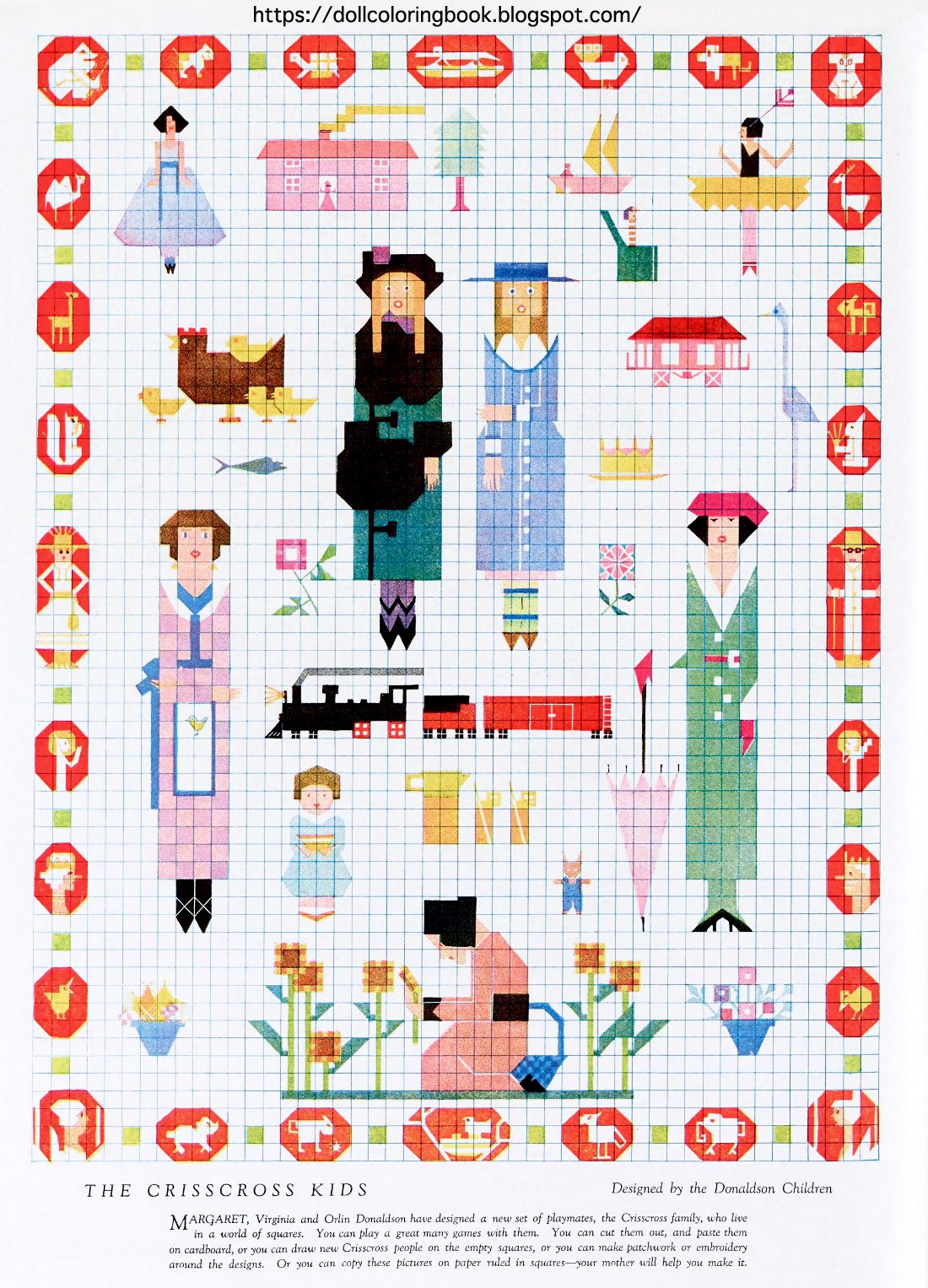
The Crisscross Kids Cross Stitch

        Margaret, Virginia and Orlin Donaldson have designed a new set of playmates, the Crisscross family, who live in a world of squares. You can play a great many games with them. You can cut them out, and paste them on cardboard, or you can draw new Crisscross people on the empty squares, or you can make patchwork or embroidery around the designs. Or you can copy these pictures on paper ruled in squares-your mother will help you make it. Last, but not least, you can stitch these cross stitch people on any fabric item you like: pillow cases, towels, blue jeans or for a framed picture too! Designs by the Donaldson Children - authentically 1920s!

Not for resale. Click to download the largest version.

A nursery cross stitch sampler by Helen Grant from 1928.

Wednesday, June 15, 2022

Needlework Samplers by Young Girls

       A(needlework) sampler is a piece of embroidery produced as a demonstration or test of skill in needlework. It often includes the alphabet, figures, motifs, decorative borders and sometimes the name of the person who embroidered it and the date. The word sampler is derived from the Latin ‘exemplum’ – an example.

Sampler by Margaret Barnholt, age six, 1831. This needlepoint may be
printed from your home computer for a doll's house. You will need to
resize it to a smaller version however, before printing it.
 

      The oldest surviving samplers were constructed in the 15th and 16th centuries. As there were no pre-printed patterns available for needleworkers, a stitched model was needed. Whenever a needlewoman saw a new and interesting example of a stitching pattern, she would quickly sew a small sample of it onto a piece of cloth – her ‘sampler’. The patterns were sewn randomly onto the fabric as a reference for future use, and the woman would collect extra stitches and patterns throughout her lifetime.
      16th Century English samplers were stitched on a narrow band of fabric 6–9 in (150–230 mm) wide. As fabric was very expensive, these samplers were totally covered with stitches. These were known as band samplers and valued highly, often being mentioned in wills and passed down through the generations. These samplers were stitched using a variety of needlework styles, threads, and ornament. Many of them were exceedingly elaborate, incorporating subtly shaded colors, silk and metallic embroidery threads, and using stitches such as Hungarian, Florentine, tent, cross, long-armed cross, two-sided Italian cross, rice, running, Holbein, Algerian eye and buttonhole stitches. The samplers also incorporated small designs of flowers and animals, and geometric designs stitched using as many as 20 different colors of thread.
      The first printed pattern book was produced in 1523, but they were not easily obtainable and a sampler was the most common form of reference available to many women.
      The earliest dated surviving sampler, housed in the Victoria and Albert Museum in London, was made by Jane Bostocke who included her name and the date 1598 in the inscription. However, the earliest documentary reference to sampler making is recorded in 1502 The household expense accounts of Elizabeth of York record that: ‘the tenth day of July to Thomas Fisshe in reward for bringing of concerve of cherys from London to Windsore … and for an elne of Iynnyn cloth for a sampler for the Quene’.
        A border was often added to samplers in the 17th century, and by the middle of the 17th century alphabets became common, with religious or moral quotations, while the entire sampler became more methodically organized. By the 18th century, samplers were a complete contrast to the scattered samples sewn earlier on. These samplers were stitched more to demonstrate knowledge than to preserve skill. The stitching of samplers was believed to be a sign of virtue, achievement and industry, and girls were taught the art from a young age.

Friday, August 14, 2020

30 Tiny Floral Embroidery Ideas for Doll Clothes

      The floral examples on this plate are given as suggestions for motifs to be worked into groups, borders, and patterns. Each one is worked on a geometrical construction or from the construction of the stitches, and in no case is a drawing necessary. The color and form of most of them are impressions of wild flowers. It has been necessary to limit the descriptive details to the colors and the names of the stitches used, but study of the photograph should make the working clear.
Embroider these 30 miniature flowers on any doll's
apron or dress to embellish it for Spring!
  1. Three scarlet berry-stitches.
  2. Orange buttonhole, knot center, and green fern stem.
  3. Green coral stem, detached-chain, and fly-stitches, with flowers of orange and red detached-chain. 
  4. Green detached-chain leaves, flowers of cyclamen, and mauve detached-chain and fly-stitch stems. 
  5. Crimson coral  stem, green fly-stitch, and cyclamen detached-chain florets. 
  6. Green coral stem, fly-stitch, and detached-chain, with flowers of yellow fly-stitch and orange detached-chain. 
  7. Green fly-stitch stem, pale-blue detached-chain flowers, orange cross-stitch center and deep-blue detached-chain buds. 
  8. Jade detached-chain leaves and fly-stitch stem, flowers of mauve petal-stitch and blue fly-stitch. 
  9. Deep- blue petal-stitch, green detached-chain leaves. 
  10. Yellow detached-chain, jade fly-stitch stem. 
  11. Mauve detached-chain flower with orange knot center, green tail-chain and cable. 
  12. Crimson paired-buttonhole circle. 
  13. Mauve detached-chain flower, green fly-stitch stem. 
  14. Green thorn-stitch stem, graduated pink flowers of twisted-chain spirals. 
  15. Stem of green fern-stitch flower of green tail-chain with orange wave-stitch edging. 
  16. Green chain-feather and cyclamen French-knots. 
  17. Green thorn-stitch stem, crimson buttonhole, green coral ring and blue French-knot center. 
  18. Orange coral knot rings with green detached-chain leaves. 
  19. Green fern-stitch and detached-chain, flowers scarlet detached-chain with black French-knot centers. 
  20. Green coral and detached-chain, flower yellow cable with orange straight-stitches and twisted-chain buds. 
  21. Green coral, detached-chain and fly-stitch, mauve detached-chain buds and flowers with yellow
    straight-stitch centers. 
  22. Jade fern-stitch, straight-stitch, and laid-stitch leaves, flowers pale and mid-blue detached-chain. 
  23. Green fern-stitch, tail-chain and fly-stitch, flowers pale and mid-pink tail-chain and detached-chain. 
  24. Pink detached-chain round green twisted-chain spiral. 
  25. Green detached-chain, blue buttonhole, and mauve detached-chain. 
  26. Gold-brown detached-chain and coral, orange rosette, scarlet straight-stitches and berry-stitches. 
  27. Green coral and detached-chain, mauve tail and cyclamen detached-chain. 
  28. Trefoil of green petal-stitch. 
  29. Jade detached-chain and straight-stitch, blue rosette flower and buds, pink knot centers. 
  30. Green Romanian-fern and scarlet berries.
Visit Excellent Embroidery Channels for Doll's Clothes at YouTube: