Showing posts sorted by date for query clock face. Sort by relevance Show all posts

Wednesday, September 3, 2025

Groceries and Notions

Harkin's General Store in West Newton, Minnesota. National Register of Historic Places.

       Julius Caesar Taylor's general store in West Concord, Vermont, looked pretty much like any other of the eighties. The front of the white frame building with upstairs living quarters gave on an open porch and faced the packed dirt of Main Street. The back dropped down a banking above Higgins' sawmill
        Push into its warmth on a sub-zero morning and you breathed the fragrance of calicoes, ginghams, challies, flannel sheeting, denim, heavy silks (even velvets), along with stronger odors from leather boots, kerosene, coffee beans lately pulverized in the big red hand-grinder, rich country cheeses, pickles in an uncovered keg, and chunks of hardwood burning in the big cast-iron stove. 
       These mingled aromas greeted me New Year's Day of 1888 as I began my service in the Taylor store, unaware of the course in public relations I was about to take. At nineteen I boasted no storekeeping experience. I measured only five feet four, but I was a cordy little fellow for all that. 
       A fellow needed to be husky to work in a country store in an era when produce came mainly in barrels or hundred-pound bales. Clerks had to maneuver these without the sissy's aid of moving belts or rubber-tired trucks-muscle did it. 
       Barrels of flour, barrels of red McIntoshes, barrels of "West Indy" molasses-or, on occasion, huge hogs heads of dark syrup. Barrels of potatoes from back-hill farms; of pickles, salt pork, sugar, and coarse salt. Barrels of flaky, round St. Johnsbury crackers baked in the next town, ready for chips of butter out of some farm wife's firkin. Bales and kegs of dried salt codfish to vary the West Concorder's diet of perch, pickerel, and horned pout taken from Hall's Pond
       All too often I found I must face up to a slippery green barrel of kerosene a 300-pounder—which must be hoisted to a box top or rough horse, a kerosene can's height above the floor. Then I must pierce it for the flow which would fuel lamps to set Concord's hillsides a sparkle at lighting-up time. 
      The uncounted hundreds of flour barrels I loaded into-then out of J. C. Taylor's Dry Goods and Grocery Store! Almost every farmer's order began with, "I'll take a barrel of flour." 
       Mr. Taylor, father of six, had been previously served by my second cousin, Elmer Reed, and our business arrangement was much the same as that between him and Elmer. My pay would be in the form of room, board, laundry (with which went some mending), and a salary of a hundred dollars a year.
       A hundred dollars a year meant a full year. Vacations, summer or winter, were not in style and not even expected by a country store clerk of the period. A year was a year was a year. But once, out of my fifteen months' service, I did get off for a two-day fish- ing trip to Cow Pond, an unheard-of lay-off. 
       Puttering round the yard goods section my first week of employment, I overheard Mr. Taylor talking with a farmer out front. 
       "I can say one thing for Elmer Reed," he said to John Pratt, "and I can't say it of any other clerk. At the end of the month he always had his full pay coming to him." 
       "Old Man," I silently promised my fifty-year-old boss, "you're going to say that of me, too.” Accordingly, every month I received intact, with not one penny deducted, my wages of $8.13. 
       J. C. Taylor sensibly closed down at 9:00 P.M. Thus my hours ran roughly from 7:00 A.M., when I came to sweep the floor and light a fire in the hungry box stove, until the Town House clock in its thin, slow chime struck the conclusive hour of nine. 
       That gluttonous stove I must feed daily ate up sixteen-inch-long sticks of hardwood with rapid gulps, and following the second winter of my employment, every last stick fed into the iron creature was cut by me. 
       Youthfully confident, I made brags in spring that I would saw all the logs in the yard below Taylor's store within the space of one week. This would be twenty cords of wood. Release me from store duties; let Charlie Dowse, a good hand at filing saws, keep mine keen at all times, and I would do the rest. Mr. Taylor understood boys. On assuring me that I could never fulfill my brags, he knew the woodpile was already as good as stacked. 
       It was April, frost out of the ground, trees budding into tremulous green, our little Moose River splash- ing boisterously under the rainbow arch of the covered bridge my Temple uncles had helped build. 
       I picked up my razor-sharp saw and selected a piece of four-foot wood from a forbidding pile. All too soon I discovered that every log was as thick around as a stovepipe-some thicker. Others defied a full cut, unless I turned them over. Twenty cords in one six- day working week! Over three cords of hardwood a day, each piece cut twice in two, a pile four by twenty-four feet in size. Charlie Dowse better be good with his filing. 
       Word got out that Jim Frye was in back of Taylor's, sawing and sweating. Idlers came to gape and advise, friends to mock Little Jim desperately and publicly busy. Like an artist on a street corner, I must not glance up at spectators and become distracted. In silence, I sawed. Across the river in his frame house, Charlie filed. Harry and Fred Taylor were caring for their father's little roan in my place- I had a stove, not a horse to feed. 
       Early mornings, when plump robins were scuttling about our small common looking for grubs and bobo-links were calling from meadows nearby, I was at my saw horse. Late twilight found me still sawing, while the sun disappeared in a wedge of gold between two hills over Waterford way. It was a very weary lad who triumphantly flung down his tools on Saturday night and a grateful one when his boss said, "Don't touch another stick; the boys and I'll stack it." But I'd kept my word; sawed every last piece. 
       A shy stripling early in my employment, I was at some confusion if waiting upon the womenfolks, fitting them to ladies' high button boots; rolling out bolts of yard goods while trying not to rumple chambray and print with my clumsy hay-rube hands nor muss the handsome poplins; snipping off eighteen inches of satin for a hair bow; measuring scrim and buckram; displaying whale bone corsets nested in deep, slim boxes. 
       Townsfolk, at first, generally asked for Mr. Taylor to wait on them. Yet, slowly, I began to learn. When I was hired, deep red and blue, such as my sisters, Sabiny and Maryann, knit into mittens and mufflers, were about the only colors I could identify. Presently I could glibly recommend ashes of roses, indigo blue, garnet, pistache green, and the popular seal brown. Once customers came directly to me, I knew I had caught on. 
       By then, I could deftly flip over a length of ribbed silk or bombazine or select the box of tortoise shell hairpins some woman needed for pinning on her Sun-day-go-to-meeting switch of hair. I could advise a maiden as to a gold-plaited breast pin or locket that lay, with small wares, displayed in one of two glass cases. 
       Over these cases I daily fluffed my chicken feather duster. They were chockablock with a conglomeration of small items as divergent as penny candy and shaving mugs. The list of goods carried by a country storekeeper was astronomical. Cuff buttons and scythe snaths; common pins and mop pails; seeds and jackknives on and on it went. Whips, brooms, ax handles, herd's-grass, oil lamps-to believe in such variety, one needed to see the stock in its odd juxtaposition. 
       All day, townspeople and farmers, their wives and children, drifted in to buy or gossip. But after the early supper hour enjoyed at West Concord, six or eight men would settle down on a pair of simple benches, light up pipes or take out quids, and a chew- ing match (conversation and tobacco) would begin. Always the stove was a focal point of the gathering in the wintertime-but winter or summer, the saw- dust box set on iron feet was in demand by tobacco chewers. 
       When I became a storekeeper in Concord years later, I had had enough of wood cutting, so I installed a towering affair for stove coal that had a round wooden drum to use as a warming oven. The stove taught me several lessons-first, that the fiercely in- dependent aged just won't admit that they forget-to do so is to admit to old age. 
       Orville Lawerence was a regular customer, an old man at the time I became a proud young storekeeper. One bleak day he tied his piano buggy to the nearest hitching post, stamped in shaking snow from his leg- boots, and placed his mittens on the stove drum to dry. When he left, carrying his groceries but not his mittens, I called to him as he opened the door. 
       "Mr. Lawerence, haven't you forgotten some- thing?" 
       "I say have I?” 
       "Your mittens, sir." 
       For a second he hesitated, glancing at the stove, then realizing this as a confession of forgetfulness, moved on out.
       "I say I'm not ready for 'em yet," came the face- saving reply. Extra steps to return and recover the mittens were worth proving he'd not forgotten. 
       On the lighter side was my experience with Cousin Elmer's young wife Ella, who lived just over the store. Because my stove's damper had not been properly adjusted, gas built up inside the heater. One morning the gas blew up without warning, and following the course of the stovepipe, decided to explode right in the middle of Ella's neat bedroom. She came down at once to confront me as belligerently as a naturally gentle soul could. 
       "What have you done to my bedroom?" she cried out in dismay. 
       All I could do was offer to pay for removal of the coating of black soot showered from floor to ceiling- and watch my damper thereafter.  
       By the time I owned a store my cousin Elmer owned one also and there was a third merchant in town, H. F. G. Branm, who ran a store somewhat above us. All three of us inevitably stocked the long heavy woolen undergarment in two sections then favored by both men and women for winter wear. From this stock I was to learn a lesson in discretion. As a husbandly gesture, Harve Judevine elected to take home a set of nether garments from all three stores-perhaps planning to compare the merchandise. Wifelike, Mrs. Pratt repudiated the choice of her spouse. But not until months later-in a hurried trip to each storekeeper-did the buyer redistribute the goods. And then, not to rightful owners. 
       Elmer got a top piece of Branm's; this had become moth-eaten in places. I got the corresponding moth-eaten lower piece and a shirt of Elmer's while Branm got my full set. 
       Now I'd always kept a civil tongue in my head, as a young man should, while serving Squire Judevine, but I had no particular love for him. To accept moth holes along with belatedly returned goods was asking too much. 
       I confided to Elmer that unless I got my own garments back, I'd sue. Elmer must have quoted me and word been taken back to Judevine for he came in one day to say in farm-frank language it did not lie in me to do this. We parted coldly. Next day Branm brought back my rightful set, but with lofty righteousness I said, "Trot those down to Judevine-be bought 'em and he can return them himself." 
       An old doctor in the store, and my sponsor when I joined the Masons, spoke up. He advised against my act as Mr. Judevine was a man of influence; I listened, accepted the underwear from Branm-but not until years later did I fully appreciate the wisdom of his counsel. 
       J. C. Taylor, my first employer, had never trusted out. Nor Curt Stacey, a small storekeeper who had above the top of a time-silenced clock in his store the warning, "No tick here." But as I expanded, I began to let folks charge what they bought. Cleveland's panic lay on the land. Income began to fall below outgo. I had made a practice of presenting a trifling gift when a bill was paid, a bag of candy, a fat cigar. As the panic grew these gifts were infrequent. 
       "Give me a barrel of flour," a customer would say. Then as I loaded it into his wagon, "I'll pay ye later." 
       With hop farmers in the vicinity this had been a familiar way of doing business, "Pay ye when I sell my hops" was as good as a bond. But this Cleveland panic was different. 
       Was Uncle Charlie, village blacksmith, really a prophet when he uttered his dictum against the Democrats on Cleveland's election? A die-hard Republican, he sat down to read the day's news in tipped-back comfort. One glance at the news-Cleveland had actually been elected! Whang! Down came feet and chair legs as Uncle roared, "The country's gone to #*&#; and I can't help it!" 
       Certainly it seemed so to me as bills rolled in and wholesalers in Boston and Portland began pressing me. A backer wanted cash on his loan. Contributing as usual to both Methodist and Universalist church funds was impossible. Store-keeping, once my delight, was now my nightmare. "Never Trust Out''—why hadn't I heeded Mr. Taylor? 
       Farmers still drove round with no cash but "pay- ye-later" promises. Men still perched on countertops in the late evening to gossip and argue. If I turned out the lamps to be rid of them, it being summer, they kept on with their talk, seated outside on the family- size barrels of flour ($4.25) strung out from the store door in a long row. Plenty of goods went out over my counter-but no gold in any form seemed to come back. 
        There arrived a heart-breaking period of forced inventory and settlement, and the humiliating public auction of my goods. "Finis" was written to my career as a storekeeper. 
       At last I locked my door for good. It was dark. Pleasant summer quiet lay upon West Concord. Tomorrow was only another day. 
       Four down trains from Portland would whistle at the crossing by the grist mill as usual. Four up trains would whistle in reverse. Horses from Ed Joslin's livery stable would clomp past to Uncle Charlie's for treatment for interfering. Farmers from the corner would drive up with their wives' grocery lists- kerosene flour-stick cinnamon-a nipple for baby's bottle-but not to Jim Frye's store; he was done for - done! 
       I stuck the door key in my pants pocket for the last time-like a freed slave flung my hands high. 
       "Thank God, that's over!" I cried. 
       Yet I've always been glad I first tended, then owned, a country store for it taught me many valuable lessons I could never have learned from books.
Old-fashioned canned goods, black and white clip art restored by kathy grimm
for students to use in their journals and for other things...

Sunday, August 31, 2025

The Water Dolly

The Water Dolly 
 by Sarah O. Jewett

       The story begins on a Sunday in the middle of August. Elder Grow had preached long sermons both morning and afternoon, and the people looked wilted and dusty when they came out of church. It was in the country, and only one or two families lived very near, and among the last to drive away were the Starbirds: Jonah and his wife, and their boy and girl. The wagon creaked and rattled, and the old speckled horse hung his head and seemed to go slower than ever. It was a long, straight, sandy road, which once in a while led through a clump of pines, and nearly all the way you could see the ocean, which was about half a mile away. 
       There was one place that Prissy was always in a hurry to see. It was where another road turned off from this, and went down to the beach, and every Sunday when she came from church she hoped her father would go this way, by the shore. Once in a while he did so, so she always watched to see if he would not pull the left-hand rein tightest, and there was always a sigh of disappointment if the speckled horse went straight on; though, to be sure, there were reasons why the upper road was to be enjoyed. Mr. Starbird often drove through a brook which the road crossed, and there were usually some solemn white geese dabbling in the mud, which were indignant at being disturbed. Then there was a very interesting martin-house on a dingy shoemaker's shop, а little church with its belfry and high front steps and tall windows, all complete. Today Mr. Starbird turned the corner decidedly, saying: "I shouldn't wonder if it was a mite cooler on the beach. Anyway, it can't be hotter, and it is near low water." Prissy sat up very straight on her cricket in the front of the wagon, and felt much happier, and already a great deal cooler. 
       "Oh, father," said she, "why don't we always go this way? It would be so much nicer going to meeting." 
       "Now, Prissy," said Mrs. Starbird, "I'm afraid you don't set much store by your preaching privileges;" and then they all laughed, but Prissy did not quite understand why. 
       "Well," said her father, "it is always three quarters of a mile further, and sometimes it happens to be high tide, and I don't like jolting over the stones; besides, I see enough of the water weekdays, and Sunday I like to go through the woods."
       It was cooler on the shore, and they drove into the water until the waves nearly came into the wagon, and Prissy shouted with delight. When they drove up on the dry sand again, she saw a very large sea-egg, and Sam jumped down to get it for her.
       "Wouldn't it be fun," said she, " if I could tame a big fish, and make him bring me lovely things out of the sea?" 
       "Yes," said Sam, "or you might make friends with a mermaid." 
       "Oh, dear!" said Prissy, with a sigh, "I wish I could see one. You know so many ships get wrecked every year, and there must be millions of nice things down at the bottom of the sea, all spoiling in the salt water. I don't see why the waves can't just as well bring better things in shore than little broken shells, and old, good-for-nothing jelly- fishes, and wizzled-up seaweed, and fish-bones, and chips. I think the sea is stingy!" 
       "I thought you were the girl who loved the sea better than 'most anything," said her mother. "I guess you feel cross, and this afternoon's sermon was long. I'm sure the sea gives us a great deal. Where should we get any money, if your father couldn't go fishing or take people sailing?" 
       "Oh, I do love the sea," said Prissy; "I was only wishing. I don't see, if there is a doll in the sea, - a drowned doll, you know, with nobody to play with it, - why I can't have it." 
       Soon they were at the end of the beach, by the hotel, and then they were not long in getting home. 
        Just as they were driving into the yard a little breeze began to come in from the east, and Mr. Starbird pointed to a low bank of clouds out on the horizon, and said there would be a storm before morning, or he knew nothing about weather.
       "It is a little bit cooler," said his wife, "but my! I am heated through and through." 
       Prissy put on her old dress, and after supper she and Sam went out in the dory with their father, to look after the moorings of the sailboat, and then they all went to bed early. And sure enough, next morning there was a storm. 
       It was not merely a rainy day; the wind was more like winter than summer. The waves seemed to be trying to push the pebbles up on shore, out of their way, but it was no use, for they would rattle back again as fast as they could every time. The boats at the moorings were rocking up and down on the waves, and you could hear the roaring of the great breakers that were dashing against the cliffs and making the beach beyond white with foam. 
       There was not much one could do in the house, and there were no girls living near whom Prissy could go to play with. 
       The rainy day went very slowly. For a while Prissy watched the sandpipers flying about in the rain, and her father and Sam, who were busy mending a trawl. Finally she picked over some beans for her mother. Sam and his father went down to the fish-houses, and after dinner Prissy fell asleep, and that took most of the afternoon. She couldn't sew, for she had hurt her thimble-finger the week before, and it was not quite well yet. Just before five her father came in and said it was clearing away. "I am going out to oil the cartwheels and tie up the harness good and strong," said he, "for there will be a master pile of seaweed on the beach tomorrow morning, and I don't believe I have quite enough yet." 
       "Oh!" said Prissy, dancing up and down, "won't you let me go with you, father? You know I didn't go last time or time before, and I'll promise not to tease you to come home before you are ready. I'll work just as hard as Sam does. Oh, please do, father!" 
       "I didn't know it was such a good thing to go after kelp," said Mr. Starbird, laughing. "Yes, you may go, only you will have to get up before light. Put on your worst clothes, because I may want to send you out swimming after the kelp, if there doesn't seem to be much ashore." And the good-natured fisherman pulled his little girl's ears. "Like to go with father, don't you? I'm afraid you aren't going to turn out much of a housekeeper."
       The next morning, just after daybreak, they rode away in the cart, - Mr. Starbird and Prissy on the seat, and Sam standing up behind, - drawn by the sleepy, weather-beaten little horse. It had stopped raining, and the wind did not blow much; the waves were still noisy and the sun was coming up clear and bright. They saw some of their neighbors on the way to the sands, and others were already there when the Starbird cart arrived. For the next two hours Prissy was busy as a beaver, picking out the very largest leaves of the broad, brown, curly-edged kelp. Sometimes she would stop for a minute to look at the shells to which the roots often clung, and some of them were very pretty with their pearl lining and spots of purple and white where the outer brown shell had worn away. Prissy carried ever so many of these high up on the sand to keep, and often came across a sea-egg, or a striped pebble or a very smooth white one, or a crab's back reddened in the sun, and sometimes there was a bit of bright crimson seaweed floating in the water or left on the sand. Besides these, there seemed to be a remarkable harvest of horse-shoe crabs, for at last she had so many that she took a short vacation so as to give herself time to arrange them in a graceful circle around the rest of her possessions, by sticking their sharp tails into the sand. It was great fun to run into the water a little way after a long strip of weed that was going out with the wave, and once, as she came splashing back, trailing the prize behind her, one of the neighbors shouted good-naturedly: "Got a fine, lively mate this voyage, have n't ye, Starbird?" 
       Nearly all the men in the neighborhood were there with their carts by five o'clock, and there was a great deal of business going on, for the tide had turned at four, and when it was high there could be no more work done. The piles of sea-weed upon the rocks grew higher and higher. In the middle of the day the men would begin loading the carts again and carrying them home to the farms. You could see the great brown loads go creaking home with the salt water still shining on the kelp that trailed over the sides of the carts. You must ask papa to tell you why the sea-weed is good for the land, or perhaps you already know? 
       But now comes the most exciting part of the story. What do you think happened to Prissy? Not that she saw a mermaid and was invited to come under the sea and choose out a present for herself, but she caught sight of a bit of something bright blue in a snarl of seaweed, and when she took it out of the water, what should it be but a doll's dress! 
       And the doll's dress had a doll in it! Just as she reached it, the wave rolled it over and showed her its beautiful face. Prissy was splashed up to the very ears, but that would soon dry in the sun, and oh, joy of joys, such a dear doll as it was. The blue she had seen was its real silk dress, and Prissy had only made believe her dolls wore silk dresses before. And, as she pulled away the seaweed that was all tangled around it, she saw it had a prettier china head than any she had ever seen, lovely blue eyes, and pink cheeks, and fair yellow hair. Prissy's Sunday wish had certainly come true. What should she wish for next? 
       But she could not waste much time thinking of that, for she found that the silk dress was made to take off, and there were little buttons and button holes, and such pretty white underclothes, and a pair of striped stockings and cunning blue boots - but those were only painted on. Never mind! There was a the salt water would have ruined real ones. string of fine blue and gilt beads around her neck, and in the pocket of the dress - for there was a real pocket - Prissy found such a pretty little handkerchief! Was this truly the same world, and how had she ever lived alone without this dolly? Some kind fish must have wrapped the little lady in the soft weeds so she could not be broken. Had a thoughtful mermaid dressed her? Perhaps one had been a little way out, hiding under a big wave on Sunday, and had heard what the Starbirds said as they drove home from church. Prissy was just as certain the doll was sent to her as if she had come in a big shell with "Miss Priscilla Starbird" on the outside, and two big lobsters for express men. 
       How surprised Mr. Starbird was when Prissy came running down the beach with the doll in her hand. Sam was hot and tired, and did n't seem to think it was good for much. "I wonder whose it is?" said he. "I s'pose somebody lost it." 
       "Oh, Sam!" said Prissy, "she is my own dear dolly. I never thought she was not mine. Can't I keep her? Oh, father!"- and the poor little soul sat down and cried. It was such a disappointment. 
       "There, don't feel so bad, Prissy," said Mr. Starbird, consolingly, "I wouldn't take on so, dear. Father'll get you a first-rate doll the next time he goes to Portsmouth. I suppose this one belongs to some child at the hotel, and we will stop and see as we go home." And Prissy laid the doll on the sand beside her, and cried more and more, while Sam, who was particularly cross today, said, "Such a piece of work about an old wet doll!" 
       "Oh," thought Prissy, "I kept thinking she was my truly own doll, and I was going to make new dresses, and I should have kept all her clothes in my best little bit of a trunk that grandma gave me. I don't believe any Portsmouth doll will be half so nice, and I should n't have been lonesome any more." 
       Wasn't it very hard? 
       But Prissy was an honest little girl, and when her father told her he was ready to go, she was ready too, and had the horse-shoe crabs transplanted from the sand into a strip of kelp in which she had made little holes with a piece of sharp shell, and the best shells and stones were piled up in her lap. She had made up her mind she could not have the doll, and she looked very sad and disappointed. It was nearly a mile to the hotel, and it seemed longer, for the speckled horse's load was very heavy. Prissy hugged the water dolly very close, and kissed her a great many times before they stopped at the hotel piazza. 
       Mr. Starbird asked a young man if he knew of any child who had lost her doll, but he shook his head. This was encouraging, for he looked like a young man who knew a great deal. Then a boy standing near said, "Why, that 's Nelly Hunt's doll. I'll go and find her." 
       Mr. Starbird went round to see the landlord, to arrange about carrying out a fishing-party that afternoon, and Prissy felt very shy and lonesome waiting there alone on the load of seaweed. She gave the dolly a parting hug, and the tears began to come into her eyes again. 
       In a few minutes a tall, kind-looking lady came downstairs and out on the piazza, and a little girl followed her. Prissy held out the doll without a word. It would have been so nice to have her to sleep with that night.
       "Where in the world did you find her, my dear?" said the lady in the sweetest way; "you are a good little girl to have brought her home. What have you been crying about? Did you wish she was yours?" And she laid her soft white hand on Prissy's little sandy, sunburnt one. 
       "Yes 'm," said Prissy; "I did think she was going to be my doll, and then father said somebody must have lost her. I shouldn't like to be the other girl, and be afraid she was drowned." 
       This was a long speech from our friend, for she usually was afraid of strangers, and particularly the hotel people. The lady smiled, and stooped to whisper to the little girl, who in a minute said, "Yes, indeed, mamma," aloud. 
       "Nelly says she will give you the dolly," said the lady. "We are sorry her clothes are spoiled, but someday, if you will come over, I will give you some pieces to make a new dress of. It will have to be either black or white, for I have nothing else here, but I can find you some bright ribbons. Nelly left her out on the rocks, and the tide washed her away. I hope you will not be such a careless mamma as that." 
       "Haven't you any dolls of your own?" said Nelly; "I've six others. This one is Miss Bessie." 
       "No," said Prissy, who began to feel very brave and happy. "I had one the first of the summer. It was only a rag baby, and she was spoiled in the rain. Oh, I think you're real good!" And her eyes grew brighter and brighter. 
       "Dear little soul," said Mrs. Hunt, as she went in, after Mr. Starbird had come back, and they had gone away, "I wish you had seen her hug that doll as she turned the corner. I think I never saw a child seem happier. It had been so hard for her to think she must give it up. I must find out where she lives."
        You will know that Prissy went home in a most joyful state of mind. In the afternoon, directly after dinner, she went down to the playhouse, carrying the shells and crabs, and she and the new dolly set up housekeeping. The playhouse was in a corner where there was a high rock at the end of a fence. There were ledges in the rock that made some shelves, and Sam had roofed it over with a few long boards, put from the top of the rock to the fence, so it was very cozy. There were rows of different kinds of shells and crab-backs, marvelous sea-eggs, and big barnacles by the dozen. Sam had rolled in a piece of driftwood, that had been part of the knee of a ship, and who could want a better sofa? There was a bit of looking-glass fastened to the fence by tacks, and there had been some pictures pinned up that Prissy had cut out of a paper, but these were nearly worn out by the rain. A bottle, with a big, jolly marigold in it, stood on a point of the rock that she called her mantelpiece. Besides these treasures, she had a china mug, painted red, with "Friendship's Offering" on it in gilt letters. The first thing she did was to go down to the shore, where she was busy for some time washing the dolly's clothes, which were very much spotted and crumpled, and full of sand and bits of sea-weed. The silk dress could only be brushed, her mother told her, and would not be quite clean again but after all it was grand. 
       Prissy's "wash" was soon hung out on a bit of a fishline, stretched near the playhouse, and the doll, who had been taking a nap during this time, was waked up by her new mother. The sun shone bravely in at the door, and all the shells glistened. Prissy counted the sails out at sea, and noticed how near the lighthouse looked that day. "When I go out there again, you may go, too," said she to the doll; "you won't be a bit seasick, dear." 
       The water dolly looked happy, as if she felt quite at home. Nelly Hunt came over next morning with a box of "Miss Bessie's" clothes and a paper of candy, and when she saw the playhouse she liked it so much that she stayed all the rest of the morning, and came to see Prissy ever so many times that summer before she went away.

Wednesday, August 27, 2025

"Tattercoats"

Tattercoats dancing by Rackman.

       In a great Palace by the sea there once dwelt a very rich old lord, who had neither wife nor children living, only one little granddaughter, whose face he had never seen in all her life. He hated her bitterly, because at her birth his favorite daughter died; and when the old nurse brought him the baby he swore that it might live or die as it liked, but he would never look on its face as long as it lived. 
       So he turned his back, and sat by his window looking out over the sea, and weeping great tears for his lost daughter, till his white hair and beard grew down over his shoulders and twined round his chair and crept into the chinks of the floor, and his tears, dropping on to the window-ledge, wore a channel through the stone, and ran away in a little river to the great sea. Meanwhile, his granddaughter grew up with no one to care for her, or clothe her; only the old nurse, when no one was by, would sometimes give her a dish of scraps from the kitchen, or a torn petticoat from the rag-bag; while the other servants of the palace would drive her from the house with blows and mocking words, calling her "Tattercoats," and pointing to her bare feet and shoulders, till she ran away, crying, to hide among the bushes. 
       So she grew up, with little to eat or to wear, spending her days out of doors, her only companion a crippled gooseherd, who fed his flock of geese on the common. And this gooseherd was a strange, merry, little chap and, when she was hungry, or cold, or tired, he would play to her so cheerfully on his little pipe, that she forgot all her troubles, and would fall to dancing with his flock of noisy geese for partners.
       Now one day people told each other that the King was traveling through the land, and was to give a great ball to all the lords and ladies of the country in the town near by, and that the Prince, his only son, was to choose a wife from amongst the maidens in the company. In due time one of the royal invitations to the ball was brought to the Palace by the sea, and the servants carried it up to the old lord, who still sat by his window, wrapped in his long white hair and weeping into the little river that was fed by his tears. 
       But when he heard the King's command, he dried his eyes and bade them bring shears to cut him loose, for his hair had bound him a fast prisoner, and he could not move. And then he sent them for rich clothes, and jewels, which he put on; and he ordered them to saddle the white horse, with gold and silk, that he might ride to meet the King; but he quite forgot he had a granddaughter to take to the ball. 
       Meanwhile Tattercoats sat by the kitchen-door weeping, because she could not go to see the grand doings. And when the old nurse heard her crying she went to the Lord of the Palace, and begged him to take his granddaughter with him to the King's ball. 
       But he only frowned and told her to be silent; while the servants laughed and said, "Tattercoats is happy in her rags, playing with the gooseherd! Let her be - it is all she is fit for." 
       A second, and then a third time, the old nurse begged him to let the girl go with him, but she was answered only by black looks and fierce words, till she was driven from the room by the jeering servants, with blows and mocking words. 
       Weeping over her ill-success, the old nurse went to look for Tattercoats; but the girl had been turned from the door by the cook, and had run away to tell her friend the gooseherd how unhappy she was because she could not go to the King's ball. 
       Now when the gooseherd had listened to her story, he bade her cheer up, and proposed that they should go together into the town to see the King, and all the fine things; and when she looked sorrowfully down at her rags and bare feet he played a note or two upon his pipe, so gay and merry, that she forgot all about her tears and her troubles, and before she well knew, the gooseherd had taken her by the hand, and she, and he, and the geese before them, were dancing down the road towards the town. 
       "Even cripples can dance when they choose,” said the gooseherd. 
       Before they had gone very far a handsome young man, splendidly dressed, riding up, stopped to ask the way to the castle where the King was staying, and when he found that they too were going thither, he got off his horse and walked beside them along the road. 
       "You seem merry folk," he said, "and will be good company." 
       "Good company, indeed," said the gooseherd, and played a new tune that was not a dance. 
       It was a curious tune, and it made the strange young man stare and stare and stare at Tattercoats till he couldn't see her rags. Till he couldn't, to tell the truth, see anything but her beautiful face. 
       Then he said, "You are the most beautiful maiden in the world. Will you marry me?" 
        Then the gooseherd smiled to himself, and played sweeter than ever. 
       But Tattercoats laughed. "Not I," said she, "you would be finely put to shame, and so would I be, if you took a goose-girl for your wife! Go and ask one of the great ladies you will see tonight at the King's ball and do not flout poor Tattercoats." 
       But the more she refused him the sweeter the pipe played, and the deeper the young man fell in love; till at last he begged her to come that night at twelve to the King's ball, just as she was, with the gooseherd and his geese, in her torn petticoat and bare feet, and see if he wouldn't dance with her before the King, and the lords and ladies, and present her to them all, as his dear and honored bride. 
       Now at first Tattercoats said she would not; but the gooseherd said, "Take fortune when it comes, little one." 
        So when night came, and the hall in the castle was full of light and music, and the lords and ladies were dancing before the King, just as the clock struck twelve, Tattercoats and the gooseherd, followed by his flock of noisy geese, hissing and swaying their heads, entered at the great doors, and walked straight up the ball-room, while on either side the ladies whispered, the lords laughed, and the King seated at the far end stared in amazement. 
       But as they came in front of the throne Tattercoats' lover rose from beside the King, and came to meet her. Taking her by the hand, he kissed her thrice before them all, and turned to the King. 
       "Father!" he said - for it was the Prince himself - 
        "I have made my choice, and here is my bride, the loveliest girl in all the land, and the sweetest as well!" 
       Before he had finished speaking the gooseherd had put his pipe to his lips and played a few notes that sounded like a bird singing far off in the woods; and as he played Tatter-coats' rags were changed to shining robes sewn with glittering jewels, a golden crown lay upon her golden hair, and the flock of geese behind her became a crowd of dainty pages, bearing her long train. 
       And as the King rose to greet her as his daughter the trumpets sounded loudly in honour of the new Princess, and the people outside in the street said to each other: 
       "Ah! now the Prince has chosen for his wife the loveliest girl in all the land!" 
       But the gooseherd was never seen again, and no one knew what became of him; while the old lord went home once more to his Palace by the sea, for he could not stay at Court when he had sworn never to look on his granddaughter's face. if you could only 
       So there he still sits by his window, see him, as you may some day, - weeping more bitterly than ever. And his white hair has bound him to the stones, and the river of his tears runs away to the great sea. Retold by Flora Annie Steel

More princesses who started out with only rags to wear:

Tuesday, January 28, 2025

Dear Valentine, Part 1

The intro illustration.
    Lucy Ross beamed with pleasure as she came into the Antiques Show. Lucy loved old things. She always enjoyed going "antique-ing" with her mother, wandering through all the antique shops in town. But this show was like a hundred wonderful stores all rolled into one!
   "Lucy," her mother said, "this is a perfect place for your game of pretending."
   But Lucy was already in a dream world, imagining herself dressed in a hoop skirt and bonnet. As she walked along beside her mother, her eyes lit on a large four-poster bed with a bright yellow canopy. Tossed across it was a blue and red and yellow patchwork quilt. Lucy pretended that she was living in olden days and that this was her bedroom.
   She hardly heard her mother saying, ‚''I wish I could walk around with you. But I promised I'd take care of the refreshment stand this afternoon."
   "That's all right," Lucy said dreamily. ''I'll see everything." Suddenly her eyes lit up. "I might even find an idea for the class assembly program."
   "That would be wonderful," her mother said as she gave Lucy a big kiss. "My stand is right by the door if you need me."Goodby," Lucy smiled, returning the kiss.
   She floated on by herself, past a series of small booths. They were like little rooms with one wall missing. In one booth, gold bracelets, pins and rings sparkled on top of a long counter.
   Lucy did not stop.

A glass case filled with very old things.

   Farther down the hall she spied a real old-fashioned horse-carriage, painted shiny red and black. Only the horses were missing. Lucy hurried toward it, already imagining herself climbing up onto the seat. 

The old-fashioned horse-carriage.

The doll's tea party.
   "I wonder if anyone would mind," she thought.
   But, before she even reached the carriage, something else caught her eye! She stopped short and drew in her breath. "Oh, how lovely!" she gasped, looking into a charming little room.
   The booth was perfectly arranged to look like a small parlor. There was a little sofa and even a real piano. Best of all was the tea table, beautifully set with fine china and linens. Around the table sat almost life-sized dolls dressed in romantic old-fashioned costumes with big skirts and high waists.
   Lucy stared and stared, and suddenly her game of "pretending" brought them to life!
   "Do come in, Lucy," the hostess seemed to be saying. ''I'm so glad you've come to our our tea party."
   Enchanted, Lucy slid forward across the thick rug to the handsome mahogany tea table. Just as she was reaching toward a delicate china cup, a real voice sounded close to her ear. The proprietor of the booth appeared at her side.
   "I wouldn't touch that, if I were you," he said gently, pointing to a sign: "WHAT YOU BREAK YOU'VE BOUGHT"
    Lucy looked so sheepish, the man felt sorry for her. "Have you seen what's in here?" he asked, pointing to a gilt and glass curio cabinet in a corner of the room. Lucy scurried over to look.
   "What's this?" she asked, pointing to a lacy card in the cabinet.
   "That," the man said, solemnly lowering his voice, "is a very old valentine-very old." He got it out and held it importantly on the palm of his hand.
   It was a tiny, hand-painted religious picture surrounded by lace. "The nuns made it," he told her, putting it back in the cabinet.
   "Isn't it sweet?" Lucy said. "I do love valentines. I wonder when people started sending them?"
   The man rubbed his hands together. He seemed pleased that he knew the answer. "The custom began about five hundred years ago when the Duke of Orleans was captured in war and sent the first modern valentines from his prison cell."
   Lucy nodded, half listening, and squealed, "Isn't this one beautiful!" Carefully she lifted up a large glittering valentine from a lower shelf of the cabinet. She fingered its soft blue cloth forget-me-nots. They almost covered a red silk heart set in the center of silver-painted paper lace. When she opened the valentine she saw herself in a tiny mirror. Aloud, she read the poem below the mirror:

"Here's the face I'm glad I met
For you I never can forget.
How fine, how full of sweet delight
Our lives will be when our hearts unite."

   "That valentine is almost a hundred years old," the man said. "It's part of Mrs. Holly's collection."
   "Oh," asked Lucy, "who is she?"
Lucy reads the valentines.
   "Why, she collects valentines. That's her exhibit over there, near the grandfather clock." He pointed across the hall.
   Lucy thanked him and started eagerly down the aisle. She made a bee-line for Mrs. Holly's booth, at first, but it wasn't easy. There were too many attractive things to see. First a spinning wheel caught her eye, next a tinkling music box, and then a battered rocking horse. Of course, she had to get a closer look at each.   
   Without realizing it, Lucy had changed the direction in which she was headed. Suddenly she found she was in the wrong aisle. Nobody here had heard of the valentine exhibit. Lucy tried a different aisle. It seemed very crowded with people, but suddenly a merry peal of laughter made her turn around. Behind a long table stood a tall and lively lady with perky white bangs. She had a big lavender bow under her chin. A great many people were standing around her table, looking through albums of some sort, and at that moment one of them called the lady by name. She was none other than Mrs. Holly!
   Lucy edged in towards the table, and Mrs. Holly soon noticed her. ''Are you interested in valentines, little girl?" she asked. 
   "Oh, yes, Mrs. Holly," Lucy answered. To her delight, Mrs. Holly pushed a large album across the table to where Lucy stood.
   The album was open to a page headed, "VALENTINES FROM THE DAYS OF GEORGE WASHINGTON." The valentines were very simple, hand painted on yellowing paper. Tiny hearts and birds caught Lucy's eye. A rhymed note on one valentine asked for a lady's hand in marriage.
   Lucy turned the page, and here the valentines were very different. The colors were many and varied, and they were printed on pretty paper which itself had a raised design. There were even little embossed envelopes to match. Each of the small pictures was surrounded by white or gold lace. "VALENTINES FROM ABRAHAM LINCOLN'S DAY," read the typed heading.
   Suddenly Lucy was caught up in a marvelous new dream, a dream she felt could really come true. She imagined herself standing on the audi- torium platform with all her schoolmates in the audience. She was making a poetic speech about valentines and the whole school applauded her. Then she introduced Mrs. Holly and her collection! Wouldn't it be wonderful if Mrs. Holly would really come to the next school assembly?
More antiques in the shop... a spinning wheel, an old clock and a rocking horse.

   Right then and there she decided to ask her. Mrs. Holly was still busy chatting with several grownups, but Lucy decided that as soon as she could get Mrs. Holly's attention, she would invite her. Meantime, she turned to another page in the album marked LATE VICTORIAN."
   "Oh," she exclaimed, "these are the best!" These valentines were very fancy and very lacy. Lucy pulled a string on a paper rose and the paper sprang up like a spider web. She opened a paper door on another valentine to see what was behind it. As the door swung open, it revealed another, even lovelier valentine, covered with hearts and flowers.
   Just then Lucy looked up and, for a wonder, Mrs. Holly wasn't busy. She smiled at Lucy and walked over when Lucy called her.
   "Well, sweetheart, what can I do for you?" Mrs. Holly asked cheerfully.
   "I just love your valentines," Lucy said, ''and I was wondering if you could possibly come to my school and show your collection for the February assembly? Our class has to give the program," she added.
   Mrs. Holly beamed with pride. "Why, that might be fun," she said. "How would your teacher feel about it?"
   "I know Miss Chase would like it," Lucy assured her.
   "Well, I'd love to come and show my collection, but you'd better ask Miss Chase first." She fished in the pocket of her dress and came up with a small card. "Here's my address,'' she said, "And what's your name?"
   Lucy told her and thanked her and altogether was so excited that she hardly remembered to say goodby. 

Valentines from when President Washington lived.

Late Victorian Valentines.

Sunday, May 26, 2024

A Day In A Colonial Home

PREFACE: The average home today has conveniences to meet the demands of comfortable living. The heating and lighting are good. In nearly every home may be found a living room where the family assembles for rest and recreation. Here they read, sew, chat, and discuss the news. Similar scenes occurred in the colonial days, but in quite a different room. The kitchen took the place of our modern living room. The life of the colonists centered in it, for in the kitchen was the fireplace, often the one source of heat in the whole house. Its warmth and cheer and its use as a place for cooking made it the heart of the home. Here it was that the family interests and activities were centered; all the family group collected here to share the joys and sorrows of life.

HOW THE STORY CAME TO BE WRITTEN: A father came into the Newark Museum to ask help of the educational adviser.
       "I cannot get my children interested in their ancestors," said he. "They don't feel any pride in being descended from a lady who came over in the Mayflower. They say, "Oh, Charlie's uncle came over in a private yacht, and Mike's brother is going over in an airplane.'' What shall I do? If we were living at the old homestead, I could show them the hole in the shutter through which the native shot their great-uncle, and the oven by the fireside where their great-grandmother cooked for the continental soldiers, and the wedding dress of their grandmother. But the old place was sold, and everything is scattered."
       "Bring your children to the Museum," said the educational adviser. "We will show them colonial costumes and candle-molds and Native American arrows."
      "I'll try it," said the father, "but it won't be the same."
       Then came a teacher.
       "I wish," said she, "that I could make history alive to my pupils. They don't care how many men were killed in the battle of Monmouth, or what the date was when Washington crossed the Delaware."
       "We will send you some dolls in colonial costume and an old wool-carder," said the educational adviser.
       "Thank you," said the teacher. "Of course, those things will be better than nothing." 
       It was this need to see the real things that caused the Museum to build in its big hall at the top of the Newark Library a colonial kitchen, and fill it with colonial furnishings. Then the students from the Normal School dressed up in colonial clothes and went to work in the kitchen, spinning, making candles, and sewing carpet rags, and explaining these things to the children who flocked in to visit them.
       Next Miss Prescott began to play with the children who flocked there, and then the Andrews children of this story were born.
       The six or eight thousand children who were taken by their teachers to see this kitchen during the ten weeks that it stood there, many of whom then took their parents to see it, will perhaps read this story about the labors, and the play, and the love-making of Mary Jane, with interest.
       Any group of manual training boys and domestic art girls can put up such a kitchen, dress the characters, and act out such a story, and in many American neighborhoods they can borrow real things, for their stage properties.
       Of course, the story was not written to stimulate handwork or theatricals. Nor was it written to Americanize, or re-Americanize anybody. But simple stories without ingenuity of plot or striking incident have always been told by parents and grandparents and maiden aunts to the delight of children. "Tell us what happened when Grandpa was a miller‚" "Tell us about when you went to school through the woods"; "Tell us how the bear frightened Great-Aunt." These are the demands of children of all nations. The peculiarity of our situation is that so many of our children are step-children, half-children, adopted children. It is a mercy that there is an inheritance not only of blood, but of memories, of ideas, and of hopes.
       If this story stimulates emulation of the real virtues of our forefathers, who founded the country, and hence leads to real patriotism, it will have achieved the desire in the hearts of the authors and publishers. 

A Day in a Colonial Home

       Mary Jane awoke, startled. Had she overslept and not heeded her father's call? She jumped out of bed on to the strip of rag carpet laid on the cold floor. The chill of the early May morning made her shiver, and, with motherly care, she turned and straightened the patchwork quilt on her two sisters, mischievous Abigail and gentle little Dorothy, who were sleeping warmly in their feather bed. The world was a-quiver with life and sound. Mary Jane looked anxiously through the small-paned window. Surely, Providence would grant a pleasant day for the last of the housecleaning! Her mother was ill with the new baby brother and the kitchen must be cleaned before she was about again. It was not easy to do the work as well as her mother would have done it, but a bright, sunshiny day would help.
       The sun was just rising and a cool, northwest breeze was blowing the mist from the pond and gully. The sunlight sparkled on the pond which lay across the foot of the field and the breeze blew it into dark blue ripples. Mary Jane dreamed a minute. John Lewis must be in port, she thought, and perhaps he would be home to-day. His father's whaler, the Breezy Belle , had reached Gloucester the first of the week. If she planned well and hurried the work she might be able to go down to Jenny Lewis's in the afternoon to see her new dresses. Jenny Lewis was John's sister, and she had more pretty clothes than any girl in town. It would be a welcome change to visit her before supper. The past week of housecleaning had been a busy one, for the girls had cleaned the dooryard and the entry as well as the back room and the loft bedroom. Their mother, before her illness, had cleaned and aired her best front room and put back in their places the few pieces of furniture which stood in this cold and little-used room.
Figure 1. Well and Well-Sweep.
       The well-sweep creaked in the breeze, and a whiff of the smoke of the kitchen fire, pouring out of the chimney, blew up the stairway. Mary Jane straightened her simple gray dress, folding a fresh white kerchief across her breast. The neighbors called her smart and comely. She was sixteen, and tall and strong, the oldest of eight children. Her brothers and sisters knew her to be gentle as well as firm and just. They never shirked Mary Jane's orders, but they carried to her their bruised toes and cut fingers, the stitches dropped in their knitting, the knots tied in their patchwork. She bound up their hurts and set them to work again.
       "Daughter," called her father from the foot of the stairs, "the day comes on apace, and it promises a clear sky for your cleaning. Grandmother is tending your mother and the new babe, but John and I will need the porridge hot when we come back from foddering."
       Mary Jane answered her father gravely and picked up the candle to take with her to the kitchen. She called the older of her sisters. The three all slept under the low ceilings in the upstairs chamber. "Come Abigail! You are in truth a sleepyhead. Come! Everything's awake, and we have much to do! Father has called and indeed you must hurry."
Figure 2. Candlesticks. 
       In the kitchen a glowing bed of red-hot coals burned on the hearth, streaks of sunlight glanced through the eastern windows and touched the snowy, coarse cloth on the large dinner-table. Soft reflections shone from the pewter porringers hanging on the dresser; a sunbeam flecked with bright light the brass candlestick which Mary Jane set near its mate on the mantel over the hearth. In the south windows red geraniums blossomed and there was an atmosphere of homely cheer and comfort in the room. All winter, the family had gathered in the kitchen and, in its warm cosiness, Mary Jane had spun, darned mittens and knit stockings. She loved the kitchen, and she worked there happily and energetically, putting into her tasks that same heartfelt devotion to duty that her great-grandfather had brought across the sea to the Massachusetts colony more than a hundred years before.
       Her mother called quietly from the nearby bedroom, and Mary Jane tiptoed in. The baby was asleep and the sight of him in his helplessness and of her mother, always so strong and active, lying now so quiet and helpless at the beginning of a busy day, stirred her strangely. She bent awkwardly and kissed them, and blushed as she straightened up. Kisses were rare in her home, and she was surprised at herself. Her grandmother came in, and a commotion from the kitchen warned her that the boys were awake. Her three younger brothers, steady Thomas, and the twins, Asa and George, slept in the turn-down bed in the corner of the kitchen. They tumbled out and helped and punched each other into their clothes.
       "No shoes and stockings to-day, boys," Mary Jane called. "Housecleaning time, and shoes have barely lasted through the frost."
       Going to the table in the corner, she poured water into the wash basin. She washed her face and hands in the cold water, newly drawn from the well, gasping with the shock of its coldness, and rubbed her face briskly with the linen towel which hung over a roller on the door.
       Suddenly the back entry door swung open, and roly-poly Sam Dodd came in, swinging an iron pot.
        "Good-morrow, neighbors! Can you lend us a coal? As the weather grows milder I fear we tend our fire none too carefully."
       "Did you know John Lewis had come home?" he called to Mary Jane. "Some of us stopped to see him last night and Jenny came out and two or three of the neighbors. Mother says it is ungodly the way Cap'n Lewis dresses Jenny. "Fine feathers don't make fine birds," she says, and Jenny doesn't work enough to pay the Cap'n. She's a fair gad-about. He toils mightily to get the whale oil to buy her
gowns. John seems real pleased to be home, Mary Jane. He asked where you were."
       Grandmother came into the kitchen as Sam started out with his borrowed fire.
Figure 3. Porringer or Shallow Bowl. 
       "Pray tell thy mother, Sam, that the candles she helped us to make last fall are lasting well. We have treasured the choice green bayberry candles. Your mother will remember the day she helped me pick the bayberries for them. Now we do not need so much candle light, as the days grow longer. Thank her kindly for the bowl of rich soup she sent Daughter Andrews. Daughter will soon be up and about. Our new babe is six days old and strong and lusty. Hear how he cries." 
        Sam grinned and bore off his coals fallen from the burning sticks; while Grandmother took the bowl of porridge in to her daughter. 
Figure 4. Cast-Iron Skillet.
       Drawing the settles up to the table Mary Jane placed her father's chair at one end and her mother's at the other for Grandmother. Abigail and Dorothy seized the small brothers and sisters and scrubbed them clean. Whereupon the children took their porringers and wooden bowls from the dresser and stood in their places behind the settles. Abigail strained into a pail the warm, frothy milk which John, the oldest brother, had brought in, and Dorothy filled the large pewter tankard with cool milk from the cellar way. Mary Jane bustled about. She dished up from the steaming kettle on the hearth the corn meal mush, or hasty pudding, and added a large, thin Johnny cake, which she had browned in the skillet.
       The children folded their hands and bowed their heads. Grandmother had returned to the table. Father leaned over the high back of his chair and asked the Heavenly Father's blessing on home and family and sought guidance in the tasks of the day. 
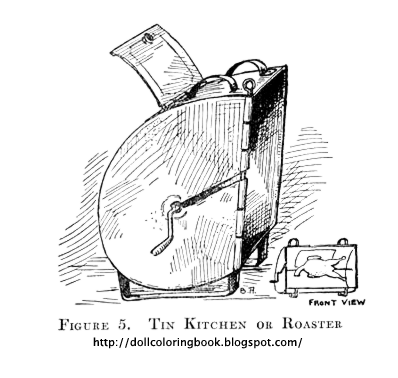
Figure 5. Tin Kitchen or Roaster. 
         Mary Jane admired her father more than anyone else in the world. Wasn't he always right? She wandered. This morning while she sat with bowed head she asked herself, wistfully, if her father ever found it hard to decide between pleasure and duty. What would he say if he knew how much she wanted to see Jenny Lewis's new clothes? Would he think her frivolous? As she raised her eyes, she found her father looking quietly at her. Somehow, she seemed to feel as if he understood her better than she did herself and she sat up straight and proud because he was her father. She felt certain that he would choose his duty however hard he found it.
       As Mary Jane ate her mush and milk, she planned her day and thought occasionally of Jenny Lewis. In Jenny's home they used a tin kitchen, or roaster, for their goose. But Mary Jane's family were poor, and they used a home-made device for roasting their goose. To a string hung in the fireplace Mary Jane would tie the goose's leg and Asa would sit in front of the fire and twist the string, so that the goose might become evenly browned. Jenny's mother used a plate-warmer, made with one side open to the heat, but Mary Jane would dip her plates into a kettle of hot water and never envy her friends their extra comforts and luxuries. However, Mary Jane did have a lively interest in new things and pretty clothes, and she said to herself that she would get through her work and have an hour or two before supper to visit Jenny whether or no.
Figure 6. Plate-Warmer
       Her father had set the churn near the hearth and the cream was warm enough for Thomas to beat. The brick oven was well heated, and she could bake apple pies, using the last of the dried apples. George should take down the few strings of apples which were left hanging on the kitchen rafters, and Dorothy should wash them at the well. It would not take long for Dorothy to clear away the dishes and fold the table-cloth and napkins. The family had few dishes and most of these were pewter bowls and porringers. A few blue dishes of Grandmother's, that she had brought from England, were left. These were used only on rare occasions. Mary Jane would wash them herself. The silver spoons and Mother's white-handled knives must be scoured with care. Abigail should attend to them and the pewter and the tin-lined copper kettles. Abigail liked to make them shine and Mary Jane knew that when one's heart is in a task the work goes quickly. There was always wool to card, and the small boys might do this in odd moments. When the fireplace was cleaned out, one of the boys must empty all the ashes into the leach barrel. Through the winter the family had saved the ashes and all grease from cooking and butchering and, in the fall, Mother would make soft soap. Mary Jane's mother and grandmother always had good luck with their soft soap, and in the clear jelly-like substance there remained little trace of the rancid grease and strong lye from which it had been made.
       The simple but nourishing breakfast was soon over. Father spoke occasionally to John about the work of the day. "The flax patch must be harrowed and sowed and the sods turned for the corn," he said.
       "This is a likely drying day, John; the wind and sun will draw the dampness from the earth, and take the dust from your rugs, too, Daughter," he added, as he rose and picked up his broad, soft hat.
       "Remember, children, that your mother has taught you to work quickly and with care. Show that you have learned your lesson well. Boys, stand ready to handle the dasher, or turn the roast. Come, John."
Figure 7. Wool Spinning-Wheel
       Breakfast finished, all became bustle and stir. Grandmother slipped briskly to her large, wool spinning-wheel. She was white-haired and full of years, but still she plied her task of spinning energetically and skilfully. She had learned it long before in a shire of England where wool was raised and made into cloth. Grandmother was graceful and dignified in carriage; for many years of her life she had walked back and forth at her wheel, lightly poised and alert. She lifted her spinning-wheel, and, with awkward help from Thomas, carried it into Mother Andrew's room.
       "I must needs be out of thy way, Mary Jane, and will spin in thy mother's room today."
Figure 8. A Cradle
       But Grandmother soon returned, holding the baby in the crook of her left arm. She seated herself near the fire and unwrapped many layers of soft woolen covers from little Samuel. Dipping her elbow into the basin of warm water at her side, she found it just right and bathed the baby quickly, wrapped him again in the folds of the flannel, and retied his little cap. She then put him in the cradle, and called Thomas to rock him to sleep.
       Mary Jane told her brothers and sisters what she expected of each of them before she pulled out her rolling-board and started to make pie-crust.
       Abigail banged the churn dasher up and down and thought eagerly of the pewter and brasses to be polished.
Figure 9. Wooden Churn
       "Thomas, methinks the wee child must be asleep. Stretch up to this churn dasher and prove yourself a dashing knave," she said. "Abigail, teach not to children such play on words," chided Mary Jane.
       Abigail frowned and said, "You were not always so proper in your speech, Mary Jane, before John Lewis came a-courting."
       Mary Jane, flushed and flustered, knocked her cap awry, and accidentally wiped a floury hand across her cheek.
       "Do you suppose that I shall be thus improved when someone comes a-courting me?"Abigail went on. "What do you think John Lewis may have made you? He has had time enough for many a turn of the hand. It is full three months since the whaler put out from Gloucester. Do you think that even a slow-witted fellow like your John may have speed in his fingers? Perchance he whittles faster than he talks?"
       "Abigail," Mary Jane interrupted, "the butter must have come. Run out to the well for fresh water. I will gather the butter while you are gone. Curb your saucy tongue, sister. Mistress Dodd is coming up the road with her pot of beans, and I would not have her hear your foolish gossip."
       "John wants the flint-lock, Mary Jane. Pass it down to me quickly. Oh hurry, kindly," Abigail called as she tumbled in at the doorway. The little boys followed close at her heels. "The dog has dug out a woodchuck in the stone wall, near the flax patch, and John thinks he can pot him. Do hasten, Mary Jane! Your fingers were not always thumbs."
Figure 10. Flint-Lock gun and pistol

       The gun was loaded, for when it was wanted it was wanted quickly, and loading was no quick matter. Throwing it over her shoulder as John would have done, Abigail ran from the house.
Figure 11. Warming Pan
       Dorothy could not bear to have killed even a woodchuck who ate the flax plants. Mary Jane knew how the child loved all dumb creatures, and she sent her out into the south door-yard, patchwork in hand. Dorothy sat down on the door-step and sewed. She was setting patchwork blocks for Mary Jane's new quilt. It was a Job's Trouble pattern and there were in it many hexagonal blocks of real India chintz, and French calicoes that Jenny Lewis had given Mary Jane. Dorothy sewed over and over with painstakingly small stitches. But the spring day enticed her, and she stole away from her stint. She poked with a stick among the roots and dried leaves in the garden border, and thought eagerly of the colors and sweet odors soon to awaken there: hollyhocks and purple stocks, candytuft and pinks, Sweet William, by the door-step, and love-lies-a-bleeding, Queen Margarets, larkspur, tiger lilies and bouncing-bet, and sunflowers to be planted here and there with corn. Dorothy played only a few minutes, for conscience urged her to pick up the unfinished square of patchwork, and she soon went back into the house. Mary Jane bade her show Mistress Dodd into their mother's room, for her own arms were deep in the butter-bowl.
       After Abigail had helped dig out the woodchuck, she brought in the two pails of clear rinsing water for the butter, and hastened to start her own task of the day. The pewter and copper should be made to shine as never before. She arranged on the far end of the dinner-table, pewter porringers, solid silver spoons, the pewter tankard and one large pewter plate and several small ones, the long-handled brass warming pan, two tall brass candlesticks and the snuffers from the mantel. She even removed the flint-lock pistols from their holsters beneath the mantel. Their brass mountings were dull and lustreless. She looked longingly at the brass clasps of Father's large Bible. When Mary Jane was elsewhere it might be possible to make them shine as they should. "You have a lively way, Abigail, when your interest is taken. If we hasten, we may have the kitchen ordered by dinner-time."

Figure 12. Snuffers
"Who is this?" Abigail exclaimed.
       Mary Jane looked up in consternation. Her father was bringing in two men; one was the minister and the other a stranger. She could hear them wiping their boots on the old rug on the porch. Abigail sprang helpfully forward to gather up and conceal her cleaning rags, and in doing so overturned the churn, half full of buttermilk! Mary Jane heard the crash, and saw the door open. Her father stepped right into the rushing stream of buttermilk before he saw there was an accident, and Mary Jane wondered stupidly why she had never noticed before how much the floor sloped toward the entry. The buttermilk ran over her father's shoes.
       This is a sad state of affairs, Daughter,"her father said with grave reproof, "but we will go around by the other door. The minister has called to see your mother, and this good man, the indigo peddler, needs some breakfast. He has traveled far this morning. Attend to his needs and I doubt not he will
show his gratitude in some way that will help you."
       Mary Jane looked ruefully at the confusion, but gratefully to her father for his forbearance. Abigail had meant well, and accidents would happen. Even if it was housecleaning time, the peddler must be fed. Father believed that all hungry people should be treated kindly. "Better to feed a dozen ungracious ones," he said, "than to turn away one deserving and needy." Mary Jane directed Abigail to bring out cold porridge and salt fish and milk for the peddler, while she mopped up the floor.
       As Mistress Dodd finished her call and came out of their mother's room, Mary Jane looked up from the floor and asked her if she would not take home a pat of new butter.
       "Twill not come amiss with hot Johnny cake, Mistress Dodd," she said, as she went on with her mopping.
       "Yes, indeed, I will be glad to have it, Mary Jane, and thank you, too. What a bother to lose the good buttermilk," she added, looking at the floor. Then she slyly pinched Mary Jane's white arm.
       "John Lewis came home last night, and they say he looks fine and hearty, Mary Jane. Think you he has learned to talk and ask questions? Have you an answer ready for him? Do not turn away your head, child, I mean naught by these bantering words. Later, I will send Sam for our baked beans. Thank you for letting us use your oven. Good-day, all."
       Mary Jane finished cleaning up the floor and scattered the children who had gathered in the kitchen. Strangers were an event, and the young ones looked at the peddler eagerly and intently. The old man sat down and drew toward him the bowl of porridge, first taking a long draught of the buttermilk near at hand. Looking up from her task, Mary Jane reproved Dorothy for staring.

Figure 13. Reel for Winding Thread
       "Take this flagon of buttermilk up to the flax patch. We saved this much in the churn.'Tis ten o'clock and Father and John must be hungry. The drink will help them through the next hour."
       Turning to Abigail, she suggested that she put out of doors the rocking-chair and small table. The Bible and work-basket and mother's reel might go into mother's room. Perhaps the peddler would help her move the settles out on the grass. Mary Jane herself knelt down on the hearth to take up the ashes.
       The peddler jumped up. "Willing hands make light work, Mistress Mary, and out go the tables and the chairs. Back again! and now, my dears, we are ready for the old settles. Came from the sturdy land of England, these did."
       Mary Jane frowned and settled her cap with dignity. "I like not too much talk. If we save our breath it will help in the lifting. Be careful of the door, please, I would not have the wood scarred."
       "Clear the ways, my hearties," the peddler called, not seeming to be disturbed by Mary Jane's dignified words, "I'm the man for that job. Up you get, Mistress Mary, and down goes Jake, the indigo peddler. I can holystone a deck, why not brush up the ashes?"
       Mary Jane looked doubtfully at her helper, but she soon admitted that he used the shovel and the turkey wing with a neat hand. Father said that it was often more generous to accept help than to give it, and so thinking, she turned to other work.

Figure 14. Kettle

       Directing Dorothy to take one kettle and Abigail the other, Mary Jane started them to cleaning the woodwork. There was plenty of hot water in the big pot which had been hanging on the crane, and there were soft soap and stout cloths. The girls were careful not to waste the soap, but they hunted for every speck and streak of dirt. Having answered a call from her mother, Mary Jane came back to the kitchen, bright-eyed, but demure. Mother had said that she wished Abigail to wash up the bricks in the fireplace, and Mary Jane would clean the windows. Master Jake had helped them generously, but they could finish up the rest of the work alone, their mother thought.       
Figure 15. Swinging Crane
       "Just as the Mistress says. I'll be off. Indigo has gone a-begging this morning, but perhaps I can sell some cochineal up the road. Good-day and the Lord bless ye!" So saying the old man bent to his pack and trudged away.
       Abigail stood and pondered. She was mischieviously interested in the change of plan. Mary Jane generally washed out the fireplace.
       "What does it mean, Dorothy? Dost think John Lewis would notice if Mary Jane's hands were smutted and grimy? '
       "Methinks 'tis best for us to stop talking and get to our work. Mother would have Mary Jane make a good impression. Mary Jane is comely, and John Lewis is not a-courting us." Dorothy's reproof was gently made, and she smiled at Abigail.
       The three sisters worked steadily and swiftly. Mary Jane appeared not to hear the whispering of the younger girls. She polished the windows, and the warm sunshine filled the room. She soon relieved Dorothy of further cleaning, and sent her into the yard under the hickory tree to sew a long seam. The child fastened her work with a sewing-bird to a little table, and sewed industriously.
       John came in just then, and took down the shoemaker's last. He wanted to get out an ugly nail from his mother's shoe. She would soon be up again. Mary Jane asked him if he would take the children out to hunt for hens' nests after he had finished. She hoped to have a custard for supper.
       A little later her father followed John in from the flax patch, and the family gathered for dinner, eating cold boiled salmon and the dried-apple pie which Mary Jane had hurriedly made in the morning. These, with milk and Johnny cake, soon satisfied the hungry workers and each was back at his task.
Figure 16, sewing-bird
       Father and John predicted a thunder shower in the late afternoon, and Mary Jane looked anxiously at the clouds. Perhaps the shower would go round? She was not much tired, she thought, and the work, in spite of accidents, was going well. It would be too hard if she finished the kitchen in time and then had to give up her visit to Jenny because of a thunder-shower. But after dinner the work went more slowly. It seemed as if she could not get things all finished and the kitchen looking just right. She was more tired than she had realized. But her determination to get away for a little time before supper grew with her weariness. She worked desperately to put the finishing touches on the room, and, after a while, it suited her. 
       Abigail and Dorothy had gone out with John and the little boys to hunt for eggs, before they washed and changed their dresses. Mary Jane's mother and the little baby brother were sleeping and her grandmother's spinning-wheel made the only sound in the afternoon's stillness. The room darkened with the coming storm. The leaves of the red geraniums moved in the rising wind, and the white, sash curtains blew out into the room. Mary Jane picked a dried leaf out of the basket of freshly laundered caps and straightened the blue calico cushion in the rocking chair. She opened the door of the brick oven where Mrs. Dodd's beans and their own had been baking since morning. The beans were baked perfectly in the round, brown pots, and their fragrant, appetizing odor filled the room. Looking about, before she went upstairs, Mary Jane felt that her mother would be satisfied with the appearance of the kitchen. The brass and irons in the fireplace and the shovel and tongs glowed from Abigail's honest rubbing. The black pots and copper kettles had been cleaned inside and out and hooked on to the swinging frame. The waffle-irons and toaster hung on the side of the fireplace and the gridiron stood on its three slender legs beside the hearth. A small fire burned red on the hearth and a gentle cloud of steam rose from the bubbling kettle. The brass warming-pan made a blob of light against the dull red bricks.
Figure 17. andirons or fire-dogs

       The dresser was white from its recent scrubbing and the pewter on it shone brightly. Grandmother's blue plates and saucers had been rearranged on the plate rail and the spoons and white-handled knives laid back in the mahogany boxes on the dresser. John had whittled and smoothed those boxes for his mother in the winter evenings. The Bible, and the New England Primer and Father's horned spectacles lay on the small table in the corner, and the cradle, with its new pink and white checked cover, stood near the fireplace. When Mother got up, the baby would lie in that all day. The floor looked nice and clean. It had been freshly sanded and the braided rugs laid carefully in their usual places before the hearth and doorway. The old gray cat had stretched himself near the fireplace, and his friend, the dog, slept beside him. 
Figure 18. Toasting-Rack

Figure 19. A Gridiron
       Mary Jane noticed that the wind had blown awry Dorothy's framed sampler which hung on the wall. She straightened it and read again the words: "Honor thy father and thy mother that thy days may be long in the land which the Lord thy God giveth thee. Dorothy Ward Andrews." She read the words soberly, and thought of her own good father. Picking up her clean cap and a basin of water, she started upstairs. A sudden clap of thunder shook the house and, with the first sprinkle of rain, the kitchen door blew open and Jenny Lewis dashed in.
       "Just in time, Mary Jane! I am glad you are through with your work! I have come to take you home to supper as soon as this shower blows over. John told me to tell you he would bring you home this evening. He has something pretty for you. I do not know what it is, but he made it and he feels sure that you will like it. You are too good, Mary Jane! I told John that you were kinder than I, but perhaps you would not like his homemade gift. I am very sure that I should not prefer it unless it were finer than you could buy in the shops." So talking on, Jenny pushed Mary Jane through the stairway door.
       The storm drove her father out of the flax patch, and in a few minutes, he hastened into the warmth of the kitchen. His wife called from the inner room and told him that Jenny Lewis had come for Mary Jane and she hoped he would allow the girl to go down to Cap'n Lewis's for the evening. There could be no harm, the mother said, in Mary Jane having well-to-do friends. John Lewis was a sober, industrious youth, even though his sister Jenny was rather flighty. She would like to have Mary
Jane go more often to visit in Jenny's home. As the mother made her ambitious little plans, the girls came into the kitchen. Mary Jane glanced shyly at her father. She was wearing her best summer dress.
Figure 20. Knife-Tray

       "Jenny has asked me down to her house for supper, Father. The storm has passed around, and the sun is coming out. I should like to go. Everything is ready to put on the table for children. Jenny says she and John will walk a piece with me when I come home."
       "Why, Mary Jane Andrews, I never said anything of the sort!" Jenny exclaimed, "John sent word he wanted to bring you home."
       Mary Jane's father looked at her searchingly and gravely. Mary Jane had not meant to tell a fib but she was always bashful when she spoke of John Lewis. Could there be a smile in her father's eye? She thought not. She dropped her own eyes and waited. In a minute her father spoke:
      "Better not go out to-night, Daughter. Your mother will be up in a day or two, and then there will be more freedom for you. Responsibility will not hurt any lass and a small disappointment is better than a pleasure taken at the wrong time."
       "Tell John," her father added as he turned to Jenny, "that we shall be glad to see him when he calls up here. I hear that your father has made another successful trip. It is a hard and dangerous life he lives on the sea. May the Lord prosper him." Then Mary Jane's father went out.
Figure 21. spectacles and Bible
       Jenny flung herself into the rocker and spoke angrily to Mary Jane. "I am glad indeed that my father is not a cross-patch! What does your father think? Just because he is one of the elders in the church must his daughter have no pleasure? He does not give you any gay dresses. Even your best dress is just this blue one with a white kerchief. It is not fair, and now he will spoil our little pleasure. I believe he likes to forbid you to do things, just because he knows you will obey. Why do you? Come with me and show your father you have a right to a few minutes in the day! Perhaps he does not approve of me! Well, I do not care. Come, Mary Jane. Come down and see my new dresses. Your father said, "Better not go out to-night‚" he did not forbid you to go. You can tell him that when you come back. Oh, what is the use of coaxing! You look just as stubborn as your father. Good-by, I am going home!"
Figure 22. Wheel for Spinning Flax
       "Come back here, Jenny Lewis!" Mary Jane called after her. "I am glad I look like my father! He has a perfect right to keep me at home if he wants to. Folks feel sorry because your father has to work so hard and spend so much of his money on clothes for you. I like pretty clothes too, but if my father thinks I am putting too much thought on myself, he tells me so. He shows me my duty."
       Mary Jane pulled her flax-wheel toward her and whirled the wheel rapidly. "My father believes I will grow in grace and patience for big sorrows and disappointments if I bear little ones cheerfully. What kind of practice are you getting, Jenny Lewis? It is wicked to talk about a father as you have talked about mine. I am not disappointed one bit about not going to your house. I like my homespun dresses and I can make linen as fine as you get in your dresses from England. When I get the kitchen cleaned and the floor sanded and the white curtains in place I feel happy. It is my work and it pleases my mother and I like to do it. Father does not say much about our work, because he expects us to do it well. He knows work is good for us. But what are you doing, Jenny? All you think about is pretty dresses and looking gay. I am glad Father thought I was needed here at suppertime‚ but I will come down to your house some other night," Mary Jane said more gently.
       "Perhaps you are right, Mary Jane, but you need not get so cross about it. I may be lazy, I suppose, but I do not see what there is about work that makes you like to do it, and in disappointment, even a little one, that makes you glad to bear it."
Figure 25. Spider or Skillet with Bail
       "Jenny, I cannot explain. I like to cook and clean and spin and knit. That's the way I feel. It isn't hard. I don't mean to be conceited or think myself better than other people, but somehow when my father is strictest with me something inside of me likes it. Here comes Dorothy with a bunch of pink and white arbutus. It grows late up in the woods. How pretty it is! Our Pilgrim grandmothers must have been glad to see it peeping up from the snow after their long, hard winters. Who is this coming in with the boys? Why, it is your brother John! Jenny, will you and John stay to supper with us?" Mary Jane turned to her friend eagerly.
       "Yes, Mary Jane, and I will help you with the dishes and, after supper, John shall tell us stories about his voyage. It is just as well we were disappointed! I will try to be a more dutiful daughter, Mary Jane. I guess Father and Mother like to have me visit you. They chide me for my heedless ways."
       The girls and boys came trooping in together and Mary Jane pushed aside her flax- wheel and stirred the embers on the hearth, laying on fresh sticks. John Lewis met her with awkward shyness and dropping a bulky package on the chair beside her said, "Open it later, Mary Jane. It is for you. I whittled it out in spare minutes aboard the Breezy Belle."
       Jenny called across the room. "Hurry up, John Lewis, and all of you boys wash while we help Mary Jane dish up the beans. It is supper time, and she has asked you and me to stay. Here is Sam Dodd, Mary Jane."
       ''Oh yes, he wants his mother's beans. They are the ones in the back of the oven, Jenny. Please help him."
       "We shall be glad to help you while your oven is being repaired, Sam. Tell your mother to send in anything she wants to have baked."
       "Do open the door for him, John. It would be a pity for him to drop the beans and spoil his mother's supper."
       So, laughing and hurrying, Mary Jane and her helpers soon had on the table their supper of baked beans and brown bread, custards and cool drinks of milk. After supper, Father asked his family and the company to gather for prayers at once for he had an errand up the road and wished to get back early. The planting and housecleaning days were hard ones and he knew that his folks needed to get to bed in good season if they wanted to do good work the following day. 
 Figure 23. Powder-Horn
       Mary Jane placed a candle on the table near the Bible and the children drew up their stools and Father's chair. Father read the twenty- third psalm and knelt to pray. He thanked the Lord for the blessings of the day, the fair weather and plentiful food and his helpful sons and daughters. He prayed that all young souls, untried in the furnace of life, should lean on the Lord and strive to do their duty nobly as He would show it to them. He prayed earnestly and rose from his knees weary but heartened. The young folks went gravely about the task of clearing away the dishes. But when Father Andrews departed, their solemnity gave place to mirth and jolly fun. John raked open the coals and brought out a little popcorn that had lasted through the winter. Thomas agreed to pop it for them, and John took down his powder-horn. He wanted to finish whittling the design on it. Dorothy coaxed Jenny down on the settle to tell about her visit in Boston and Mary Jane brought out a skein of soft, white wool.
       "Perhaps you will hold this for me, John Lewis? I am going to knit a hood for the new babe Samuel, but the wool must first be wound in a ball."
       "No, Mary Jane, there is a better way to hold that worsted than on a man's outstretched arms. Open the package I brought you and look within."
Figure 24. Swift for Winding Yarn
       Mary Jane untied the hempen cord fastened about the bundle John had brought in and the boys and girls gathered near, with jest and laughing glances. So John Lewis had made their sister something! Well, he always looked as if he liked her, but this was proof indeed. What could it be, so bulky and strange looking? Would Mary Jane never get it out? She handled the string slowly (almost lovingly, John Lewis hoped). But at last the covers fell off on her lap, and she held out a dainty and beautifully polished swift. John took it from her, and, placing it on the table, dropped over the outspread spokes, her skein of white worsted. He quickly found the end of the skein, and placing it gently in Mary Jane's hand, bade her wind the ball. As the reel turned slowly and Mary Jane's ball grew large and soft, she lifted her eyes gratefully to John Lewis. The others had withdrawn to the settles and fireplace and John made bold to whisper as he leaned across the corner of the table;  "Mary Jane, will you walk out with me on the Sabbath? Twill be a long six months before we put to sea again, and, perhaps, in that time you may come to like a slow fellow like me. Maybe I can make you a chest to put your caps and linens in while I am home. That would make you think of me when you put things in it after I am gone. Will you walk with me, Mary Jane?"
       Mary Jane twirled the reel and examined the cunningly wrought initials of her name on the side and flushed a lovely color when she discovered J. L. John Lewis just below them. She gazed laughingly at John and nodded her head, but her shy whisper left him speechless: "I do not think you are a slow fellow, John, and I like you now. I have liked you a long time! I have a chest and it is half full of fine linen. I have been busy."
       "Mary Jane, did you think of me as you spun the linen and dyed the wool?"
       Mary Jane nodded again and picked up her knitting-needles. Her father came in and John jumped to his feet.
       ''Elder Andrews, may I have Mary Jane for my wife? She likes me, she says, and we need not wait? Will you let us have the banns published this Sabbath approaching? I am twenty, sir, and Mary Jane is sixteen. That is only a year younger than my father and mother were when they married and came to the colony."
       "Daughter, is this your wish?" her father asked.
       A solemn hush fell on the group in the kitchen. Grandmother stood in the doorway and gazed affectionately on the oldest daughter of their family. She knew the sterling worth of the girl John Lewis desired for his wife, and she knew that if these young people married, another home would be established in the colony which would be a power for righteousness and godly living.
       Mary Jane looked steadfastly at her father, and tucked her hand under John's arm as she answered: "Yes, Father."
       "Then God bless you both, my children, and may you believe all that is required in this world is for you to live justly, to love mercy and to walk humbly with your God."
       So saying, he walked quietly from the room. The brothers and sisters crowded about Mary Jane and John, and Jenny whispered as she put on her bonnet: "Mary Jane, I like your father."
       Mary Jane smiled gently. A peace and happiness had come into her heart that knew no words. She turned to John to say good-night. Her father's blessing shone from her loyal, brave eyes, and John Lewis knew that he was truly fortunate among men.

Hearth Kitchen at Wentworth House

More About Colonial Homes: