Sunday, July 7, 2019

How to fix floppy necks on dolls...

       Here is a common problem with some dolls. You found the perfect doll at resale but . . . it's torso doesn't support the head. Your doll has floppy neck or floppy head syndrome! No kidding, that is what the condition is called.
       This is a result of either poor construction or the use of the wrong material. I recently purchased a doll with this condition for a few dollars. It was very easy to fix simply by replacing the materials that were used to stuff her body.

I didn't hesitate to buy a new doll with floppy head. Her condition was easily corrected by
replacing her new stuffing with cotton. Polyester fiber is too soft for a 18inch child doll.
       The manufacture had stuffed her torso with polyester fiber, a material often used in the filling of baby doll bodies, to give them extra softness. This is preferred when the doll is representing a new born infant, because that type of doll is usually carried non-stop and suited to a small cradle.
       However, for a free standing, 18 inch, child doll, this material is not a good choice. The doll will always be too limp to stand on her own. Thereby, making her an unattractive, inexpensive alternative to the pricier American Girl doll standard. 
       So, I opening up her fabric torso with a seam ripper and removed all of the polyester fill before replacing it with 100 percent cotton batting; this is the fill that resolved this new doll's floppy neck. Then I stitched up the opening in her back using a invisible hand stitch. She is now better than new.
       Now you'd think that a manufacture of dolls would know better, right? They do, however, if they are purchasing materials in bulk from one source, they can do so at a lower price point and this is what most likely took place.
       In case you are wondering if you could do the same by using half polyester and half cotton, don't bother. The doll's body will eventually collapse again. The polyester does not compact enough inside the torso to make it stiff. Fill the doll with tightly compressed cotton balls or cotton batting and you will never have the problem again.

Fixing Floppy Necks:

       I added the softer polyester fill beneath the neck of both the porcelain and vinyl versions of my 
Bello baby dolls. Although my investment was only a few dollars, my fondness for these 
twin molds was too great to allow them opportunity for damage I could not repair.

        What child or adult could resist these little faces? Baby dolls by Venezuelan designer, Yolanda Bello, in the 1990s, are notorious for their fragility. Their bodies were stuffed with pellets and polyester fill so that they would feel limp like newborn babies. However, this also meant that the porcelain versions were not likely to survive outside of a curio cabinet, even in the arms of an adult.
       Ashton Drake also sold identical designs in vinyl materials, so that parents had the option of giving a durable doll to a child. But their bodies had little stuffing about the neck and shoulders as well and even if the doll's heads were no longer breakable, the bodies of these dolls could be easily torn and tattered within a short duration of play.

Saturday, July 6, 2019

Vinyl Clip Art Records for Doll Crafts

       A phonograph record (also known as a gramophone record, especially in British English, or record) is an analog sound storage medium in the form of a flat disc with an inscribed, modulated spiral groove. The groove usually starts near the periphery and ends near the center of the disc. At first, the discs were commonly made from shellac; starting in the 1940s polyvinyl chloride became common. In recent decades, records have sometimes been called vinyl records, or simply vinyl or even vinyls. Read more...
       Cut and paste these albums/records back to back or sandwich a piece of light weight cardboard between two sides, if you would like your doll's records to be sturdier for play. The following clip art is intended for child crafts and play. It is not to be redistributed from any other website or sold for profit.
Printable 12-inch LP Vinyl Records with colorful labels.

Printable 45 RPM vinyl records with colorful labels.

Thursday, July 4, 2019

DIY Patriotic Pinwheel Cookies for American Girl Dolls

You can cover a small box with white typing paper, and tie the lid shut with white twine,
 to make your cookies look like they were purchased fresh from Grace's French bakery.
Because red, white and blue are also the colors of Great Britian's and France's flags,
our pinwheel cookie crafts would also be fun to include in a doll bakery overseas! 

        Above is a fresh baked box of patriotic pinwheel cookies for our American Girl dolls to share at their 4th of July picnic. These are easy to craft with just a small amount of oven bake clay. To make the process even faster, purchase colored clays in advance. If you are frugal like me, suffer through the process of mixing the red and blue to avoid holiday traffic!

Don't forget to throw away the sticky, clay mess left on the wax paper as soon as you have 
rolled it out with a glass! I doubt that this stained clay can be washed from any kind of fabric.

        You can color white Sculpey by kneeding in acrylic paints. It's a very messy business so I don't exactly recommend the process if you can purchase factory colors. Above you can see that I was able to combine the acrylics with the oven bake clay to create some relatively bold colors. Make sure that if you choose to do this, work on top of wax paper and when you roll it out with a glass, sandwich the clay between wax papers.
       Roll out the colored clays: red, white and blue and stack these on top of each other. You can stretch out the clay a bit to ensure that there is equal coverage for all three before rolling these up together.

It isn't necessary to compress the clay much as you roll it out. Just tap it down slightly 
to remove air bubbles.

        On the left you can see that I am rolling all three colors into a log. On the right my log is ready for cutting.
I gently pressed out the edges of each doll cookie to make them look more life-like,
 before baking them.

       Above and left, I cut consistent sized cookies with a knife and layed these out on top of a cookie sheet and baked them at 275 Fahrenheit or 135 Celsius for 5 - 8 minutes. Sculpey is best baked when it is allowed to heat up with your oven and cool down slowly without the oven door ajar.
       After my pretend doll cookies cooled, I brushed them with white glue and rolled them in transparent glitter to mimic sugar.
       These pretend sweet treats will be much appreciated by little mothers in their play doll bakery.

18" Doll Size Patriotic Pinwheel Craft

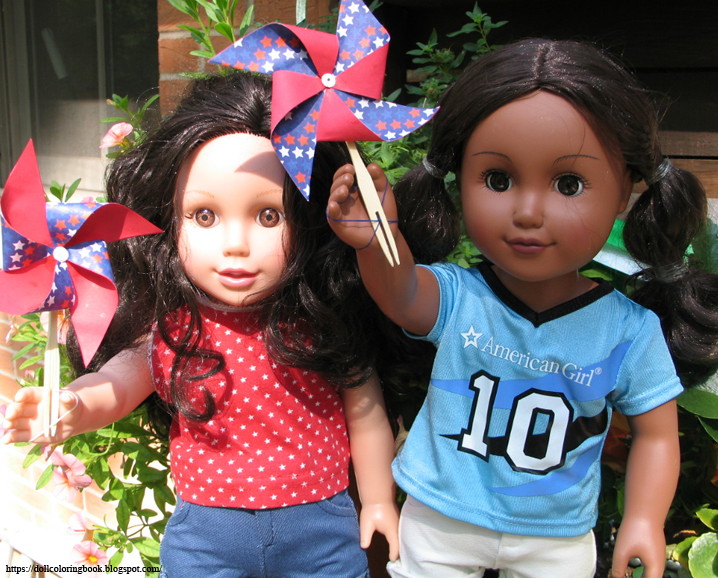
Our dolls are going to carry their very own red, white and blue, windmills in a 4th of July parade!

        Here is a simple and fun craft that you can make in only a matter of minutes for your favorite American Girl Doll. Using supplies you already have tucked away in a general craft supply at home follow the instructions below. Now your doll can have something to carry in a parade while you carry her!

One side of the pinwheel is solid red
paper, the other side is a red, white
 and blue star pattern.
 Craft Supplies:
  • scissors 
  • decorative patriotic scrapbook papers
  • hole punch 
  • double prong tooth picks
  • hot glue and hot glue gun
  • ruler
  • tiny rubber bands (for display)
  • white tacky glue
  • pin or thumb tack (for pinwheels that move)
  • left or right handed scissors (Match the correct scissors to the dominant hand of your child please.)
Step-by-Step Instructions:
  • First you will need to measure and cut four squares from scrapbook paper measuring three inches on all four sides.
  • Two of the those squares may be a solid color and two should be patterned. We used red, white and blue to emphasize the fact that these paper windmills are for a 4th of July celebration.
  • Glue two squares together with the alternate pattern and solid coupled as a pair.
  • Now fold the paper squares from corner to corner in half.
  • Then fold those triangle shapes from corner to corner in fourths
  • Open up the squares and measure 1 1/2 inch from the centers out along the folded lines with a light pencil mark.
  • Use your scissors to cut from each corner in up to the marking.
  • Fold in every other corner, tip to center point and glue.
  • Repeat this step four times.
  • You should have a pinwheel shape.
  • Punch out two centers using your hold punch and paste these to the center of each pinwheel.
  • Now hot glue each of your pinwheels to a double prong tooth pick for your dolls to carry in a 4th of July parade. (This version doesn't spin)
  • If you want your pinwheel to actually spin in a breeze, you can poke a pin through the center and then attach the pinwheel to a straw or pencil using a pin or thumb tack.
You can use a tiny rubber band to help hold the windmills in the palm of your doll's hand.

DIY Doll Sized Rockets for 4th of July!

Our dolls are seated on the lawn along with our homemade rockets, waiting for their American 4th
of July picnic to begin. However, many other countries celebrate important holidays and special
 occasions with fireworks just like Americans. If you have a doll collection from a different country,
 you might also like to make pretend fireworks for doll play

       Our dolls have decided to have a 4th of July picnic on the lawn today. They can't wait to play with their pretend rockets! 
       You can make doll fireworks just like ours using recycled paper tubes and skewers that are commonly found in supermarkets among the barbecue supplies.
       Be careful, though, not to let young toddlers or baby brothers and sisters play with these sharp ends. I clipped mine off a bit but these are certainly not the kinds of toys for little ones to run around with! They do make cute photo opportunities for the dolls however.

Paper mache rockets in the lawn
 for festive decoration only.
 Craft Supply List:
  • cardboard tubes (variety of sizes)
  • decorative, patriotic scrapbook papers
  • white school glue
  • hot glue and hot glue gun
  • newsprint
  • wooden skewers
  • twine
  • sheets of foam and card stock for rocket tops
  • masking tape
  • left or right handed scissors (Match the correct scissors to the dominant hand of your child please.)
Step-by-Step Instructions:
  1. Cut the cardboard tubes into a variety of lengths.
  2. Crush the newsprint and use masking tape to attach the ends of the newsprint to each skewer. 
  3. Wrap the ends of each skewer with the newsprint, approximately 1 - 2 inches from the end so that the skewers fit snuggly inside each cardboard tube.
  4. Drizzle some hot glue inside each tube and stuff more newsprint around each skewer to fill up the hollow insides of each 'rocket' firmly with paper stuffing.
  5. Use masking tape to close both the top and bottom of each tube.
  6. You can poke a hole using a toothpick or pin to insert a piece of twine to act as a pretend fuse.
  7. Wrap each tube with decorative paper and white glue to make the rockets festive looking.
  8. Cut circles measuring approximately 1/3 to 1/2 inches larger in diameter than the openings of your tubes.
  9. Now  cut a pie shape from each circle. (see photo below)
  10. Using a bit of hot glue on the cut opening carefully pull and attach each end to overlap slightly. This will create a pointed-end-caps for your rockets. You can use either foam sheets or card stock to shape these caps.
  11. Attach the end-caps to each of your rockets with hot glue.
  12. Twist more decorative paper around the skewer end using white glue to add more detail if you'd like.
  13. After your pretend rockets have dried, stick them into the lawn and photograph your dolls enjoying their 4th of July picnic.
Far left, Cut the cardboard tubes into a variety of lengths. Center, stuff more newsprint around
each skewer to fill up the hollow insides of each 'rocket' firmly with paper stuffing. Right,
Wrap each tube with decorative paper and white glue to make the rockets festive looking.
Left, Now  cut a pie shape from each circle. Right, Using a bit of hot glue on the cut opening
carefully pull and attach each end to overlap slightly.
Our dolls prepare for their very own 4th of July Celebration.

Wednesday, July 3, 2019

Learn About St Louis, Mo and Rainforests with Lea Clark

"Lea to the Rescue" movie for
American Girl fans
       Lea Clark is the fourteenth Girl Of The Year, released in 2016. Debuting in an episode of Good Morning America, Lea is a budding photographer from St. Louis, Missouri, and is described by American Girl as an animal lover who "discovers a world of possibilities" upon visiting Brazil, culminating in a visit to her brother in the Amazon rainforest.
       Coinciding with her release is a film entitled Lea to the Rescue starring Maggie Elizabeth Jones as the title character, along with coordinating items such as books penned by Lisa Yee entitled Lea Dives In, Lea Leads the Way and Lea and Camila, and a mobile game for iOS. American Girl has also launched an advocacy campaign with the World Wildlife Fund called "Wild at Art", urging young girls to contribute to the fund through their artistic abilities.
Our Artifacts for the Lea Clark Doll:
  1. The Jungle
  2. Jungle Animals
  3. People Who Live in The Jungle
  4. The Jungle "Maloca"
  5. The Jungle Hunt
  6. Jungle Farming and Foods 
  7. Jungle Medicine Past and Future 
  8. The Jungle Dance 
  9. Jungle Crafts
  10. Lea Clarks Behia Berry Fruit Stand - replacement accessories are coming soon!
Online Research for Themes Found in Lea Clark books: Kids Can Learn Photography:
Rain Forests of Brazil:
Endangered Animals in The Rain Forest:
Tour The City of St. Louis: Most of the attractions in St. Louis are free of entrance fees, curtesy of the St. Louis taxpayers.
American Girl Lea Clark's Books:
  • Lea Dives In
  • Lea Leads the Way
  • Lea and Camila

Learn About The Arts with Saige Copeland

Saige books by Jessie Haas for American Girl.
       Saige Copeland is the eleventh Girl of the Year released by American Girl in 2013, and the fourth Girl of the Year to represent an only child. A resident of Albuquerque, New Mexico, she has a passion for visual arts (most especially painting), and is very skilled in horseback riding.
       When Saige comes back to school, she learns that there will not be a new art class. Saige gets upset and tries to keep up her spirits and earn a new class for the school.
       A film based on her stories, Saige Paints the Sky, was released on July 2, 2013 as a made-for-television film. It aired on NBC on July 13, 2013. Saige was portrayed by actress Sidney Fullmer. An iOS app entitled Paint Ponies was also released to coincide with the doll's debut.
       The Saige doll has light skin, freckles across the bridge of her nose, blue eyes and loose auburn hair that comes in a braid. She comes in an indigo dress with a knitted/sewn geometric print belt and tan boots with belting and her face mold is the Classic mold.
Our Artifacts for The Saige Doll:
  1. Craft Small Award Ribbons
  2. Different Kinds of Balloons and Their Uses
  3. Cut blanket ponchos for 18" dolls - These have a Southwestern motifs.
  4. Dollhouse prints for horse loving dolls by Martin Stainforth
Online Research for Themes Found in Saige Copeland Books:
Balloon Festival:
Overcoming Stage Fright:
Fund Raising: 
The Importance of Supporting Art Programs for Kids:

Learn About Classical Dance With Isabelle Palmer

"Isabelle" and "Designs by Isabelle" books
 by Laurence Yep.
       Isabelle Palmer is the twelfth Girl of the Year released in 2014, making her debut on an episode of Good Morning America. Isabelle is an inspired dancer who lives in Washington, D.C.    She is excited to attend Anna Hart School of the Arts where her older sister, Jade, has been studying ballet. Her hobbies include dancing and fashion design. She designs leotards and other clothing.
       She is the first Girl of the Year to have three books – Isabelle, Designs by Isabelle, and To the Stars, Isabelle, all written by Laurence Yep. A mobile app for iOS platforms entitled Isabelle's Dance Studio was also released in line with her debut. A port of the game to Android was also released in July 2014.
       She also is the fourth Girl of the Year to have a movie about her. Erin Pitt portrays Isabelle in the movie Isabelle Dances Into the Spotlight.
       The Isabelle doll has light skin, hazel eyes, and long blonde hair with detachable pink-tipped highlights. She comes in a pink shirt with a girl in a ballet position with sequins, grey capri pants, and sparkly gold shoes, her face mold is the Classic face mold.
Our Artifacts for The Isabelle Palmer Doll:
Research Themes Found in Isabelle Palmer's Books:
Ballet Academy for Girls:
Modern Dance by Young People:
Designing For Dance:
Fan Video for The American Girl Doll, Isabelle: 
Isabelle Palmer Books by American Girl
  • Isabelle
  • Designs by Isabelle
  • To The Stars
  • Isabelle in the City

Friday, June 28, 2019

Learning History With Rebecca Rubin

Just a few titles about American Girl
Rebecca Rubin.
       Rebecca Rubin, American Girl's tenth historical character, debuted on May 31, 2009. She is a nine-year-old Jewish girl of Russian descent whose maternal grandparents and parents immigrated to the Lower East Side of New York City. Rebecca is fascinated by both various new American customs and the then-budding film industry, and aspires to become an actress despite her family's disapproval, though she still treasures and celebrates her family's Jewish traditions. Her six book series was written by Jacqueline Dembar Greene and focuses on issues related to assimilation of immigrants while maintaining familial, religious, and cultural traditions. Rebecca is the first Jewish Historical Character, however she is the second Jewish character made by American Girl.
Artifacts for Rebecca Rubin Doll:
Online Research for Themes Found in Rebecca's Books:
Russian Nesting Dolls:
New York Vaudeville Theater:
Jewish Religious Life:
Theatrical release poster.
The Perils of Pauline: The Perils of Pauline is a 1914 American melodrama film serial shown in weekly installments, featuring Pearl White as the title character. Pauline has often been remembered as a famous example of a damsel in distress, although contemporaneous reception and some analyses hold that her character was more resourceful and less helpless than the classic damsel stereotype, and she was a considerable influence on early female audiences and attracted much critical attention therefore. Read more . . .
Free Episodes at YouTube:
The Yiddish Language:
The Newsreels of WWI:
Russian Jewish Immigrants in America:
Ellis Island:
Rebecca Rubin Doll Fan Video:
Rebecca Rubin's Books:
  • Meet Rebecca
  • Rebecca and Ana
  • Candlelight for Rebecca
  • Rebecca and the Movies
  • Rebecca to the Rescue
  • Changes for Rebecca
  • Secrets at Camp Nokomis
  • A Bundle of Trouble
  • The Crystal Ball
  • A Growing Suspicion
  • The Showstopper
  • The Glow of the Spotlight
  • Rebecca's Story Collection
  • The Sound of Applause
  • Lights, Camera, Rebecca!

Sunday, June 23, 2019

Cut and Color This Old-Fashioned Paper Baby Doll

       I've redrawn this vintage, paper baby, wearing a diaper plus her fancy layette just for you to cut-out and color in! You may need some help using scissors, so be sure to ask a parent or older sibling nicely for their assistance. There are three outfits for baby, plus a slip and jacket and bonnet. Toy blocks and rattles are also included.

Vintage Postcards of Hula Dance Costumes

       Hula is a Polynesian dance form accompanied by chant (oli) or song (mele, which is a cognate of "meke" from the Fijian language). It was developed in the Hawaiian Islands by the Polynesians who originally settled there. The hula dramatizes or portrays the words of the oli or mele in a visual dance form.
       Hula dancing is a complex art form, and there are many hand motions used to represent the words in a song or chant. For example, hand movements can signify aspects of nature, such as the swaying of a tree in the breeze or a wave in the ocean, or a feeling or emotion, such as fondness or yearning. Foot and hip movements often pull from a basic library of steps including the kaholo, kaÊ»o, kawelu, hela, Ê»uwehe, and Ê»ami. Read more...

       Below are vintage postcards of girls and ladies hula dancing. They are wearing hula costumes that are traditionally now associated with the dance. If you want to sew a hula costume for a doll, these pictures should give you some idea of how a costume like this normally looks. You will need to sew a grass skirt of some kind, a floral print blouse and string some silk flowers together to make the lei (garland).


Saturday, June 22, 2019

Who Was Chief Joseph?

Photo of Chief Joseph.
       "Mut-too-yah-lat-lat" (Thunder traveling over the mountains). Chief of the Wal-lam-wat-kin, band of Chute-pa-he or Nez-Perces (nose pierced) Indians.
       Joseph was born in Eastern Oregon about 1830. The Nez Perces belong to the Sahaptin family. Lewis and Clark styled them Chopunnish, while they call themselves Numepo. The tribe have always been friendly to the whites. Chief Joseph's father counseled him to continue this friendliness. The Government took away a large portion of their reservations, to this there was very emphatic objection by the Indians, yet Chief Joseph counseled peace and meek submission. Very soon, however, nearly the whole of the remaining reservation was taken, and while the Indians were preparing to move, they were as they believed mistreated by the army, and quite a number of them were killed. Chief Joseph, however, with but about three hundred followers, showed himself a great warrior, a strategist and a statesman, as it required forty companies of United States troops, together with a small army of Volunteers, over two months to hunt down and capture this little band, and although he lacked the  warriors, yet in prowess and cunning he stands in a class with Tecumseh, Black Hawk and Pontiac. Joseph died September 22, 1904, at the Calville Indian Reservation, Miles, Washington. In the death of this noted chief, the United States lost its most celebrated Indian since the death of Red Cloud. In Chief Joseph's own story, after enumerating many wrongs which he believed had been perpetuated upon his people, he concluded: "Let me be a free man, free to travel, free to stop, free to work, free to trade where I choose. Free to choose my own teachers, free to follow the religion of my fathers, free to think, talk and act for myself, and I will obey every law or submit to the penalty. Whenever the white man treats the Indian as they treat each other, then we shall have no more wars. We shall be alike, Brothers of One Father, with one sky above us, and one country around us, and one government for all. Then the Great Spirit who rules above will smile upon this land and send rain to wash out the bloody spots made by brothers' hands upon the face of the earth."
       The Shahaptin stock is noteworthy on account of the Nez Perces and this famous chief, probably one of the most remarkable Indians of any age whose "retreat" in 1877 has often been compared to the celebrated "March of the Ten Thousand" of old. During this two months retreat Joseph forbade his men to interfere with any white non-combatants.