Sunday, September 8, 2019

Stitch Peanuts Pillows for Halloween

Pictured above, a white doll rocker for American Girl dolls, ceramic pumpkins,
  a snuggly doll afghan and Peanuts themed pillows stitched from a pair of
Halloween novelty socks.

       These Halloween pillows are made from one sock. Snoopy in the pumpkin patch and text that reads "Happy Halloween" make adorable holiday decorations for any dollhouse.
       Use Fray Check to keep the edges from unraveling while you work. I cut out the parts of my sock that I wanted for each pillow, both the back and front, from a novelty, print sock. 
       Face the right sides of your fabric together, sew a straight stitch around the pillow, leaving a one inch gap for turning the pillow inside-out. Then stuff the pillow with cotton batting and stitch the hole closed.
       I used a blanket stitch around the pillows to add strength to my seams and added a decorative button to the center of the larger pillow on both sides.

High and Low

A fat golden pumpkin lay in the field,
A golden moon rode in the sky,
The pumpkin shouted, "Hallo there, brother!
Who put you up so high?"

The man in the moon smiled a jolly smile
At the pumpkin far below--
"I'll light the sky while you light the earth,
On Hallowe'en, you know."

So the fat golden pumpkin smiled at the moon,
And the moon smiled back at him
All through the night till the morning came
And the twinkling stars grew dim.

And each felt content with the task he had 
And called it a work of love.
Though one lay low on the cold black earth
And one rode high above.

Saturday, September 7, 2019

Sew a Snuggly Afghan for Cool Fall Evenings

       Even if you don't know how to knit, you can pick up a few Halloween themed socks at the dollar store and stitch together a cozy little afghan for your dolls.
      I cut up four pair of new Halloween novelty print socks to make this patchwork version of an afghan. Young crafters may wish to use a bit of Fray Check on their edges to keep these from unraveling while they work. If you are accustomed to sewing very tight seams while working with knit fabrics and socks, you probably won't need it.
       Before backing this simple afghan, I quilted between stripes, around cat portraits and added a few spider web's inside of the solid pumpkin colored squares. You don't need to be formal about design here: use different colors of thread and make several different stitches if you prefer. I even stitched in a tiny spider on one of the webs. Holiday themed trims should be playful and spontaneous!
        I also lined the back of my doll afghan with a plain grey knit fabric and used a bit of white seam binding around the edges in order to hide imperfections. 
       These pirate kittens will look charming draped across our doll's couch this year.

These cute knit squares include stripes, stitched cob webs, pirate kitties and witch hats.
Afghans may also be called a 'throw' blankets if these are not standard sizes.

Pauline Makes Bow to Film Patrons

Pauline Makes Bow to Film Patrons
Interest Instantly Aroused
Chicago, April 4, 1914

Miss Pearl White. Born near Kansas City, Mo.,
 May 2, 1895. She was the heroine in "The Perils of
Pauline," and "The Exploits of Elaine," pictures
that made her internationally famous. She was
a typical western girl of great charm and beauty.


       "The Perils of Pauline" have begun their interesting unfolding to the thousands whose curiosity regarding the culmination of this series of thrilling pictures, will mean that the story, as told in seven of the largest Sunday papers, and thereafter shown at leading motion picture houses, will be followed closely from the first to the last reel of Pauline's perils.
       This picture series includes popular stars at the Pathe studios both in America and Europe who have been leased to make this production for the Eclectic Film Company. Those being featured, however, are the better known American ones, among whom are Pearl White, as Pauline; Crane Wilbur, as Harry Marvin, son of Pauline's guardian; and Paul Panzer in the role of Raymond Owen, trusted secretary of Hanford Marvin. The last mentioned character is impersonated by Endora Jose.
       The first release of the series is in three reels and confronts the spectator with the question, "What did the mummy say?" But to begin at the beginning--Hanford Marvin is interested in the days and people of more than a thousand years ago and is overjoyed at the announcement that a mummy is being sent to him from Cairo, Egypt. Marvin's son, Harry, centers his interest in his father's ward, Pauline, and is happy in their tennis-playing days on his father's rich estate. Mr. Marvin has a secretary whom he trusts "not wisely but too well," as the secretary is possessed of a "past" of which he is reminded by a former chum who extorts money from him.
       Marvin summons his son and Pauline from their tennis game and proposes to Pauline her marriage with his son. Pauline answers, "Some day, maybe, but first I must see the world that I may progress with my writing." Both Marvin and Harry laugh and, indignant, Pauline brings forth a new issue of the Cosmopolitan and show them a story signed "By Pauline Marvin." Surprised Mr. Marvin turns the pages and reads. The illustrations flash upon the screen, the characters in them assume life and the story is enacted before the spectators.
Pauline proves her literary ability.
        At its conclusion Marvin expresses his pleasure in Pauline's talent and says that he will send her around the world to gather material and atmosphere for stories, and that she shall go in the care of his trusted secretary. Pauline is over-joyed, Harry is not, and the secretary is visibly interested.
       The mummy arrives and the elderly Mr. Marvin is delighted with its authenticity. He cuts the burial cloth about its head and releases a braid of black hair. From the box and earthen bottle falls out. He uncorks it, a heavy gas escapes and Mr. Marvin drops into a chair, unconscious. To his deadened senses the mummy assumes life and the appearance of a beautiful young girl who steps from her burial wrappings and flits inquisitively from one to another object in the room. Finally, she sees the portrait of Pauline and approaches it. Her gaiety changes to seriousness and pointing to it, she turns to the silent figure of Marvin and speaks a message that seems to portend a warning. Somebody approaches along the hall, taking a bracelet from her arm, the girl places it on that of Marvin then, in fright, seeks the shelter of the coffin, upright against the wall. Slowly her form stiffens, fades into a mistiness of outline and when Marvin recovers, the mummy is in its box just as he had left it.
       Excitedly, he summons his secretary, his son and Pauline and tells them what has happened. He cuts the bandages at the mummy's side, inserts his hand and takes from the mummy's arm, a bracelet exactly like the one the girl had placed upon his arm. The shock of the extraordinary incident is too much for the old man and he has an attack from his heart. A doctor is summoned, Marvin's minutes are said to be numbered and he makes his will, bequeathing half of his wealth to his son and the other half to his ward, to be held in trust for her by his secretary.
       The next day the secretary files the will and incidentally, asks what disposition would be made of Pauline's share of the Marvin fortune should she die before coming of age. The lawyer replies that it would belong to him, the secretary.
       A continued-in-our-next announcement is flashed and the spectators are left to conjecture as to what the mummy said and what interesting adventures are in store for Pauline on her trip around the world.
       The story is that of Charles W. Goddard, co-author with Paul Dickey of "The Mis-Leading Lady." "The Ghost Breaker," and "The March to Sea." It is marked by the unusual in plot, by the reality of settings and scenes and by a fineness in photography. It is with genuine interest that the next release in the "Perils of Pauline" series is anticipated. Motograpy Magazine, 1914

Friday, September 6, 2019

Paper Dolls And How To Make Them

Paper Dolls, and How to Make Them 
author unknown, published in 1857 by Anson Davies Fitz

My Dear Young Friends:
       I have often pitied myself, because there were no paper dolls when I was a little girl. I supposed that all little girls, now-a-days, played with them, until a few days ago, when a lady told me that she knew a number, who had never heard of paper dolls, and then she said: "Why can't you make a little book, and tell how to make them?"  And Mary looked up and said; "Please, do, Mamma, it would make a great many children happy." So, as I am kept in my room, not able to do much else, I will try to teach you how to enjoy this delightful amusement.
       All that I knew about Paper Dolls when I was a little girl was, that sometimes a kind friend would cut from a long, narrow strip of paper, (usually the edge of a newspaper) folded a great many times, so that all could be cut at once, a row of little men and women, like this:

Even these poor little things were very amusing.
       Eight or nine years ago, I first saw a genuine modern Paper Doll. It was cut out of Bristol board, and painted to represent a little girl, very fat, with a very small waist, and a very high forehead, and red cheeks, and a great quantity of curls. It had three dresses, one pink, one blue, and one yellow, of different fashions, and a hat trimmed with flowers and ribbons. The dresses and the hat were also made of paper, painted very nicely, and could be taken off and put on again. My little girl had never before had any toy, which gave her so much delight. This was the beginning, in our family, of the reign of paper dolls, which has lasted, without interruption, to the present day.
       There are now a great many Paper Dolls in the country. I have seen many, made by the same person, who made the one that I have described. She is a little girl in Boston, who, I have heard, is paying for her education, by the money which she receives from the sale of them. They have been sold, for many years, at the book store of Munroe & Francis, in Boston where, I presume, they are still to be found. From different parts of New England, and even from New York, little girls have sent to this store for a lady, or a girl, or a boy, or a family, and have been delighted at receiving, in exchange for their shilling, or quarter or half dollar, an envelope, containing the doll and it's pretty wardrobe, larger or smaller, with more or fewer dresses, according to its price.
      Then, of late years, there have been Jenny Linds, and other famous ladies, with their elegant wardrobes. Fanny Gray too, with her history, and dresses to match, is a beautiful toy.
       These are engraved and richly colored, and made to stand upon a wooden pedestal, by fitting into a groove. They are intended to be admired and respected, but are quite too stately to be treated with familiarity. They can not be taken to the heart, and petted, like our paper dolls. Yet for those, who do not enjoy the simpler and more varried pleasure of making them for themselves, these are very delightful.
       There is also a less expensive kind of ready made dolls, printed, and sometimes colored, a dozen or more upon the same sheet of paper, with a dress and hat to fit each one, upon another sheet. The dolls and dresses have only to be cut out, and put together, and then they can go a-visiting, or do any thing which other dolls can do. But they are not what I mean by paper dolls.
       What I mean by paper dolls are little homemade figures of boys, girls, ladies, babies, any bodies, drawn on paper, and cut out, and dressed in paper clothes. These dolls and dresses may be drawn or painted, they may be well made or badly made, they may look like elegant ladies, and dear little babies, or they may be cross-eyed, and their foreheads may be larger than all the rest of their faces, and their heads may grow out of their shoulders, and their fat arms may stand out straight, and end in little knobs it is all the same, they are, little darlings,  perfect beauties, the sweetest little things that ever were seen, and nothing in the way of paper is too good to cut up and make their dresses.
       Indeed, I have sometimes thought that the more out of proportion a paper doll was, the better it was liked. I have tried to improve some, made by my little friends, by cutting down a monstrous neck or arm, but the change has not pleased them; it made the doll less like the pattern‚ which Sarah or Anna had given them. I do not think that they learn in this way to admire deformity, for they certainly would not like to see a human being shaped like their little pets. The fact only shows how much their imaginations can supply.
       And this is one of the charms of paper doll playing. Out of an old card, and a few bits of colored paper, with the aid of a pencil and a pair of scissors, a child can create for herself a world of enjoyment. Babies to be nursed and cuddled, little girls and boys to be taught and entertained, rewarded and punished, mammas to keep house, and go visiting, and take care of the little ones, with an endless variety of dresses suited to all occasions, are fashioned by their little fingers, with as much delight as they receive from the most expensive doll, which has come all the way from London or Paris. I have often been surprised at the ingenuity and taste which children have shown, in designing the different articles of dress, out of almost nothing. Little bits of paper which would else have been thrown away as useless, acquire a new value. "What a beautiful basque this will make for my little Lilly! Here's a piece of gold paper perhaps it is half an inch long by an eighth of an inch wide; it will make some buttons and a buckle for little Freddy's jacket." Even the stray feather escaped from a pillow, a nuisance to all other eyes, is seized upon as a treasure, and converted into a graceful ornament, as all must allow, to "little Willy's cap.
        But I suppose that you want to see one of these wonderful paper dolls, if you are so unfortunate as never to have had that pleasure. So I must make haste and tell you how to make them.
       What are they made of?
       Any kind of stiff paper, the backs of old cards, paste-board, Bristol board; the finer and smoother and cleaner it is, so much the better. A glazed, shiny‚surface will not answer, for you can not draw the face well upon it.
       For the dresses, I dare say that your father will give you the colored covers of old pamphlets. The unprinted backs of these are better than the glazed colored papers which you find at the book-stores, because you can paint upon them, and thus shade and trim them as you please. The folds are made by painting  with a darker shade of the same color. Some of the prettiest dresses which I have seen, have been made of white paper, painted, but it requires more labor and skill to make them well in this way, than of paper already colored. There is scarcely any kind of paper, even brown wrapping-paper, out of which you can not make something pretty for your little ladies and gentlemen. Colored note-paper or letter-paper is perhaps the most desirable material. The colored tissue motto-papers make elegant dresses for parties, if you allow your little people to go to such places. Of plain white paper you can, with the help of a pencil, make beautiful embroidered jackets, and aprons and baby dresses.
       These are the materials. Now we are ready to begin.
       You will need a pattern to guide you in your first attempts. You will find several at the end of the book. Take a piece of thin paper, and lay it over one of these, and trace it. Out out the figure that you have drawn, and you will thus have a pattern, which you can lay upon stiff paper, and draw its outline by passing your pencil around its edge. Out out this stiff one for your first paper doll, and I wish you much joy in playing with it.
       Next draw the hair and features as well as you can. Try to make the eyebrows alike, and the eyes of the same size, and looking the same way, and the nose in the middle, and do not let the mouth stretch quite from one ear to the other. The curls, I dare say, will have rather a singular appearance; but never mind, you'll do better by and by. It would be well to practice making faces upon your slate. I presume that almost every child has some older friend, who will be very glad to assist her in both drawing and painting the faces of her dolls.
       If, after your first doll is finished, you should say, "What a horrid-looking thing!" which I do not believe you will say, do not destroy it, but make a dress for it, and give it to your little sister, and she, I am sure, will be delighted, and call it "pooty baby." Then try again, and make another, and if this second one does not look as well as you hoped it would, still I think that you had best make a dress or two for it; for after all, the great charm of playing paper dolls is in dressing them. If you can not succeed in making respectable-looking faces, you can perhaps find in some fashion-plate at the end of an old magazine, a suitable head, which your mother will allow you to cut off, and paste upon a body of your own making, for these fashionable things have no real bodies; their dress is the whole of them.
       For such, and many other purposes, you will find a bottle of gum Arabic very useful. Two or three pennies worth of gum, dissolved in water, will last you a long time. There are bottles which come on purpose, with wide mouths, and a camel's hair brush fastened into the cork. With a bottle of gum Arabic, you are prepared to do great things in the millinery and dressmaking line.
       In order to help you a little, I will draw some dolls for you. On Plate I. are a boy and girl. You have only to cut them out, and they are ready to be dressed. As I said before, playing with paper dolls consists more in dressing them than in making them. It is the dressing them which makes all the difference between paper pictures and paper dolls. Even those, who can make them for themselves, are much pleased to have new patterns made for them. So I will proceed at once to the dressing, for I am in a great hurry to have you begin. 
Left, On Plate I. are a boy and girl. Right, the dresses drawn for antique paper dolls. In 1857, little boys often wore dresses until they turned four years old, during the Civil Ware through the Victorian era. This was done for the purposes of toilet training. The doll on the left is actually a little boy. The doll on the right is a girl. Read more about breeching here.
       Now the great invention, from which paper doll playing may be said to have its beginning, consists simply in making the dresses doubled at the top, so that they may stay on. I consider this one of the greatest discoveries of modern times. As soon as paper frocks could be kept on paper shoulders, you may be sure that there were plenty of little fingers ready to put them on. The way is simply this; to fold the paper of which the dress is to be made, having the fold at the top, so that the dress is cut double, front and back, and the folded part makes a shoulder-strap. You will understand this by looking at the print. (Plate III. Fig. 2.) In order to make the dress fit the doll, you must lay the doll upon the folded paper, and mark the paper so that it will fit at the neck and the belt, and, as far as possible, draw the outline of the sleeves, waist and skirt, according to your fancy. Then remove the doll, and finish the outline and cut it out. Plate III. Figs. 1 and 2, will make this plain.
       Be careful and do not cut the shoulder-straps so narrow, that they will be torn open the first time that the dress is put on. And yet the space must not be too wide, or it will look very awkward. If your paper is scant, it is not necessary that the back should be the whole length of the front, for only the front is painted and ornamented and expected to be looked at.
       Now that you have learned this great secret, the way is clear before you. You can make dresses to your hearts' content, long waists, short waists, long skirts, short skirts, long sleeves, short sleeves, flounces and furbelows.
       You have as yet learned to make only low-necked dresses, which can be slipped on over the head. But certainly the little ladies will need some high-necked dresses for winter. I am sure that you would not send your doll to school with nothing on her neck. Yet you can not expect her head, if it is paper, to go through a hole, which is only big enough for her neck. So what can you do?
       Make the neck of the dress to fit the doll's throat, and then cut a slit down the back; or, what is still better, cut the back like Fig. 2. Plate IV.
       Jackets, aprons, cloaks, mantillas are all fastened on in the same way. Collars and belts can be neatly fitted, by making them long enough to fold over on the back, as represented in Plate II. Figs. 1 and 2.
       Bonnets and caps are made of two parts, the back and front, cut in the same shape, and gummed at the edges, leaving barely room for the head to slip in.
       It is a good plan to keep each doll, with its wardrobe, in an envelope by itself. My little girls name their dolls, and write their names and ages upon their backs, and upon the backs of their clothes. You will see how useful this would be, in case one of the little ones, who can not talk, should get lost.
Plate 3, drawn in 1857, the clothes were
painted with watercolors.
      I have given you directions for only the simplest and easiest way of making dresses. You will soon learn to vary from them in some respects. In Plate V. you will see that the cloak can not be doubled at the top. The edges of the front and back are gummed together at the sides leaving a space large enough for the head and shoulders to slip through.
       In Plate VIII. Fig. 2. the white neck-kerchief which is gummed to the dress, is folded behind, leaving an opening for the head.
       In cases where one or both arms fall within the dress, like Plate III. Fig. 1, you can either cut out the lower part of the arm, so that the dress will fit beneath it, or draw and paint a false arm, as in the baby's dress (Plate VI.) or cut one from cardboard and gum it to the sleeve.
       In the sack Fig. 3, Plate III., cut a slit at the bottom of the sleeve, and slip the arm through it.
      Collars, cuffs, belts, buttons, trimmings, under sleeves, pantalettes, even legs with shoes and stockings, can be cut out and gummed to the dresses, or, when the dress is painted upon white paper, the white articles can be left unpainted, and shaded and ornamented at pleasure.
       I think that you now know enough to be left to yourselves. You will find patterns of various articles of dress for boys, and girls, and ladies, and babies, at the end of the book. These are not to be cut out, but to be copied. There is no end to the pretty things that you can make. You will, soon collect, in one way or another, the simple materials which you can convert into beautiful dresses. I am sure that you and your mothers will all agree with me in saying that playing with paper dolls is the most delightful, the most varied, and at the same time the most simple and the least expensive of all your amusements.

Note. These small volume was published in New York in 1857 by an anonymous lady. It is believed to be the oldest copy about the topic ever published in the United States! The images here have been cleaned. There are a few additional examples in the original volume that I have yet to alter and post.


Wednesday, September 4, 2019

The Life of A Wooden Doll by Lewis Saxby, 1903

To Maud, whose enthusiastic love of dolls
and things diminutive, awoke these fancies in
and suggested this series to the Author.

This series of photographs attempts, merely, a set of poses such as busy little imitators of their elders are fond of making with their accumulated doll properties. It is neither story illustrated nor illustration storied, and is marked by natural and necessary limitations which, the author trusts, will but add charm.

MRS. Dolly of Dolltown is not one of those
Who, when laid on their backs for a moment's repose,
Move a pair of big eyes that are lidless yet close.

Neither will she say "Ma-Ma" when squeezed at the waist.
In her strong wooden talk-box no squeaker is placed.
Besides, squeaking, with ladies, is not in good taste.

Though her neat little body is made out of wood,
And her hair of black paint is made smooth like a hood,
See her face ! How much better than pretty! - it's good.

No baby is Dolly, though little in size:
She's a genuine woman with motherly eyes,
And, as shortly you'll learn, she's both loving and wise.

On each day of the week she has something to do.
To her household and friends she is always so true,
And she keeps them so happy they never feel blue.


MONDAY
MRS. Dolly is happy the day
after Sunday;
All the terrors of washing can't make it
Blue Monday:
Though tubbing and scrubbing, to her
it is fun-day.


MONDAY
Out to dry on the line, in the brisk
morning air.
She is hanging the washing, so sweet
and so fair:
Heavy garments, lace collars and hose
by the pair.


MONDAY
SEE our dear little wash-lady,
happy and free;
She is cheerfully giving a Blue
Monday tea:
So real ladies do washing, as here
you may see.


TUESDAY
VERY early on Tuesday she goes,
with a will,
At the warm work of ironing clothing,
until
Nearly -  No, she is one of the sort
you can't kill.


TUESDAY
BEFORE noon all the ironing's out
of the way,
Such a wonder is Dolly, work seems
to her play:
For she bakes a large stack of fine bread
the same day.


WEDNESDAY
OH that bric-a-brac cat! he gets
tangled in wool;
Often out of the cradle the baby
he'll pull:
Dolly christened him "Mischief"
of which he is full.


WEDNESDAY
FOR her trim little body, a trim
little waist
Mrs. Dolly is making with exquisite
taste;
And in daintiest style all the trimmings
are placed.


WEDNESDAY
TO the musical hum of her
sewing machine,
Dolly pedals with vigor, and,
singing between
All the long run of stitches, her work
is serene.


THURSDAY
TO a week that is full of hard work
Dolly lends
This one day of relief, when all
Dollytown wends
To her cottage; for then she's "at home"
to her friends.


THURSDAY
IN the mid-winter season, when
evenings are long,
Mrs. Dolly gives parties, for dancing
and song:
She's the recognized leader of
Dolltown's "bong tong."


FRIDAY
THEN on Friday she turns to her
every-day cares.
All the carpets, the pictures, the sofas,
the chairs,
Free from dust Dolly cleanses;
her broom nothing spares.


FRIDAY
BUT the sweeping and cleaning
are very soon done.
For our Dolly has lunched, and at
thirty past one,
She is off in an auto, to take
a long run.


FRIDAY
FRIDAY must be unlucky, for,
what do you think?
Baby fell with a crash which made
every one blink:
But they mended his spindle
as quick as a wink.


SATURDAY
INTO Saturday's market our
housekeeper drops
Just to order some beefsteaks, some
dainty lamb chops
And a dozen frogs' legs safely trimmed
of their hops.


SATURDAY
NOW, to cook on good Sunday
is not Dolly's way:
So the food must be cooked and then
all put away
In the ice box and cupboard, for
serving next day.


SUNDAY
AFTER dinner on Sunday, she
lectures her pets
On their morals and manners, but
Dolly regrets
That old "Mischief," the cat, to be
solemn forgets.


SUNDAY
AS the churches of Dolltown are
built very small,
And the doll folk can hardly get
in them at all,
Mrs. Dolly holds service at home
in the hall.


DOLLY'S BOUDOIR
THIS is Dolly's own room where
she makes herself prim.
It is here she prepares to go into
the swim:
So she keeps her boudoir in the
finest of trim.


DOLLY'S GREENHOUSE
IN a pretty glass house, Mrs. Dolly
keeps flowers.
Which daily she waters with gentlest
of showers,
Letting in the fresh air in the bright
sunny hours.


BABY'S OUTING
EVERY day, in fine weather, she
takes baby out
In his new silver carriage, and wheels
him about;
Which makes him both healthy and
happy, no doubt.


SHOPPING
WHEN our Dolly goes shopping
she buys so much stuff
That it makes the express porter
stagger and puff
To deliver her packages, more than
enough.


PING PONG
MRS. Dolly has carried the prizes
along,
For her skill at the popular game of
Ping Pong;
She is, surely, the smartest of all the
smart throng.


DINNER PARTY
MRS. Dolly serves something
much better than wine
To the notable dollies invited to dine.
What is it? Just water, clear, sparkling
and fine.


POULTRY YARD
DOLLY'S favorite pets are the
ducks and the chicks
Who know perfectly well when it's
quarter to six;
Then, they cluster around and
"cut-up" many tricks.


HORSE SHOW
DOLLY loves the fine horses; but
then, as you know,
The most beautiful horses have very
small show
Where such beautiful dollies and
donkeys do go.


PICNIC
THERE'S nothing which gives
Mrs. Dolly delight
Quite so much as a picnic. Just see,
what a sight!
Old "Mischief" enjoys it; indeed,
well he might.


CAMPING
WHEN Dolly is camping,
excitement comes double.
Dear me! What has happened, to
cause such a bubble?
Oh, that match-holder baby! He's.
always in trouble!


THE GLORIOUS FOURTH
DOLLY'S patriot family heads
the parade,
In the Red-White-and-Blue very
gaily arrayed:
For to show her true colors she's
never afraid.


LOOK PLEASANT
HERE, a souvenir photograph
Dolly is taking
Of all the doll people and things
that are making
Her life, like this book, such a sweet
undertaking.

Make a Halloween Sticker Wreath for Your Doll House

This simple Halloween wreath project takes only a few seconds 
to put together and costs only two dollars to make if you purchase 
your supplies from a dollar store!
Supply List:
  • small Halloween stickers 
  • wire garland, orange and black for Halloween
  • small wire hook (Christmas ornament hooks)
Step-by-Step Directions:
  1. If you purchase your wire garland from the dollar store like me, you may need to trim this back a bit in order to get a uniform looking garland that is small enough for a doll sized door or wall. Whether you do this or not has much to do with where you wish to hang it.
  2. Twist the garland into a round shape and wire it in place with a few Christmas ornament hooks.
  3. Choose tiny stickers with a Halloween theme to decorate the wreath with. I just stuck mine in place without adding any extra glue. However, you may wish to add extra glue if you think the stickers might fall off.
  4. Now you can twist on an extra wire hook, in order to hang your doll's wreath on your dollhouse wall or front door.
More Dollhouse Wreaths to Craft:

How to Cut Paper Spider Webs...

Above spider webs are cut from white typing paper
using an old paper cutting technique. This fold is the
 same for cutting Christmas snowflakes.
      You can cut paper spider webs for Halloween the same way that snowflakes are cut for Christmas decorating! 
       Simply measure and cut a perfect square of any size (four equal sides) from white typing paper. Then fold it into a triangle three times. Every time you make a fold be sure to flatten the crease in your paper out with a bonefolder so that your design will be cut clean and neat. 
       Then draw a web pattern onto one side just as I have done in the photo below and cut it out. 
       Unfold the paper cut carefully. You don't want to snag it or the web might tear. 
       Now you have a lovely web to decorate your doll's house with!
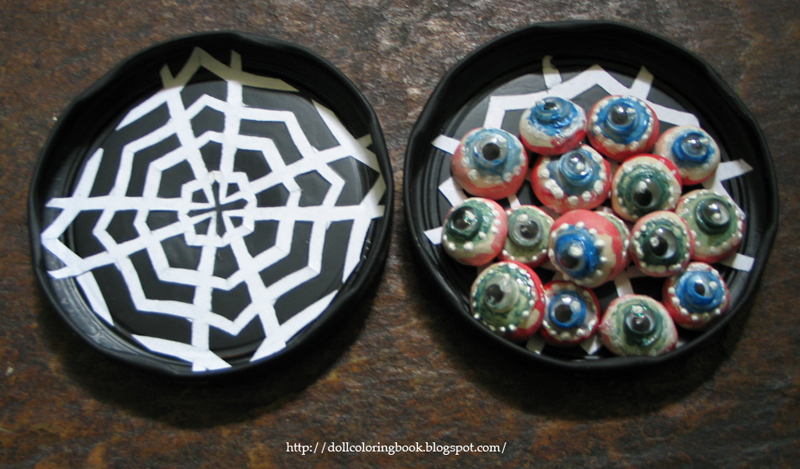
       You can pin these to the walls of your doll house or lay them on top of a doll buffet table or dining room table for decoration. I decoupaged a couple of lids with my webs to make Halloween cookie platters after painting them black. Use Mod Podge for this craft idea pictured below.

Left, are the steps used to make paper spider webs.
Right is a drawing of how the web cuts should look.


Left you can see my cookie platter with the white paper web Mod Podged on top of a black
painted lid. On the right, are some doll sized eye-ball, sugar cookies that I
made using Sculpey sitting on a spider web platter.


Chasing Shadows

It's fun to chase my shadow
Out in the warm bright sun.
I never yet have caught it
But I like to make it run.

It's just a little different
When Hallowe'en comes 'round,
Then shadows seem to lengthen
And I cannot hear a sound.

Then's the time for creepy feelings,
Not for sport and jolly play,
So instead of shadow chasing
I just want to run away.

Paint a Miniature Black Cat Planter for A Doll's Garden

       Make your doll's garden festive this year with a black, Halloween feline planter. I purchased the faux flowers for this craft at a dollar store. The terracotta pots come in sets from both dollar stores and Targets, but you can also find these at local hobby shops everywhere.

A black cat pot with large blue eyes and fuzzy tail.
Supply List:
  • miniature terracotta pot(s)
  • acrylic paints: black, blue, pink, white
  • black yarn
  • one cotton ball
  • black construction paper
  • hot glue and hot glue gun
  • artificial flowers from 
  • aluminum foil
  • green felt
Step-by-Step Directions:
  1. First paint the outside of your miniature terracotta pot with black acrylic paint. Let it dry.
  2. Crush aluminum foil to fill the inside of the miniature pot. Poke holes into this foil in order to support the faux, flowers.
  3. Remove the flowers after determining where these will go.
  4. Next, cut up small pieces of green felt to cover the foil showing at the top of the pot. Hot glue this felt around the holes made for the flowers.
  5. Cut two, small black triangles from the black construction paper. Glue these onto the pot for cat's ears. (see picture above)
  6. Paint a smaller white furry triangle inside the black ears to mimic a cat's ear.
  7. Paint a cat's face onto your Halloween planter using white, blue and pink acrylic paints. (see photo)
  8. Hot glue a piece of black yarn directly onto the surface of the pot and curl it around the side to look like a tail.
  9. I wrapped a small piece of cotton on the end of my cat's tail with a bit of glue.
  10. Now poke the artificial flowers back inside the pot's holes at the top of the planter. Now you can display a cut Halloween cat in your doll's garden!
The Ghost of a Flower.

"You're what?" asked the common or garden spook
Of a stranger at midnight's hour.
And the shade replied with a graceful glide,
"Why, I'm the ghost of a flower."

"The ghost of a flower?" said the old-time spook;
"That's a brand-new one on me;
I never supposed a flower had a ghost,
Though I've seen the shade of a tree."

DIY Doll Sized Candied Apples

These faux candied apples are approximately one inch in diameter; perfectly sized for our 18" American Girl dolls.
       Every doll lover should have a sweet, candied apple selection for her dolls to enjoy during the holidays. Ours are made from small, turned wooden apples and popsicle sticks. Just cut the sticks to the length you prefer and glue them into the centers of each apple. Let the glue dry and stiffen over night before painting the apples with red, gold or green acrylic paints. Then dip your apples into your choice of caramel, white or brown chocolate colored paints. 
       Place the wet apples on top of wax paper and let the dipped paints settle and dry so that the apples are supported by a small amount of paint pooled beneath them. This is how real caramel or candied apples are allowed to dry too! It should take several days for the paint to dry. Carefully peel away the wax paper after the paint on the apples has hardened. 
       Give the apples even more decorative surfaces with colored puff paints, glitter glue and beads that look like small hard candies, if you'd like.
Left, small 1" diameter wooden apples with flat bamboo skewers glued into the top where stems would
originate from. Right, I've painted half of my apples green and the other half red.
Left, apples drying upside down inside of a plastic egg carton. Right, apples dry on top of brown paper.
Left, Caramel Candied Apples. See a real recipe here.
Right, Jolly Rancher or Red Hots Candied Apples. See a real recipe here.
Left, White Chocolate Dipped Apples with Drizzle. See a real recipe here. 
Right, Chocolate Dipped Apples. See a real recipe here.
More Candy Apple Crafts:

Craft Cute Bottle Cap Puddings for Halloween

Top, Spider Puddin' Pies for the doll's Halloween Fun!
Bottom, Jack-O-Lantern Puddin' Pies the size of a nickel.
    These tiny Halloween puddings are sure to be popular with any dolls this coming October! You will need to collect bottle caps for the project, so be on the look out for them. Ask your older family members to save the bottle caps that have the fewest amount of dents. Sometimes these can get too bent up to use twice if they are removed forcibly from the bottle.

Supply List:
  • discarded, clean bottle caps
  • puff paints: black, white
  • orange glitter glue
  • Sculpey or any oven bake clay
  • tan acrylic paint (for the pie crusts)
  • tiny paint brushes
Step-by-Step Directions:
  1. First, remove the sticky plastic liners from the under side of the bottle caps. This can be difficult to do if you are very young. Ask an adult to help you.
  2. Take a small bit of oven-bake clay and press it into the lip of the bottle cap and bake at 275 degree oven for five to seven minutes. (see photo below)
  3. Let the bottle caps cool completely and then squeeze black and/or orange puffy paints into the middle of the caps. This will be your doll's pudding.
  4. It may take several days for the puffy paints to dry depending upon the weather or where you live. After this paint has hardened, use a small amount of tan acrylic paint to cover the edges of your pie crusts.
  5. If you wish to paint the spider webs, use two colors of puffy paints to make these tiny marks. I chose a transparent sparkly white and a regular white for my painted webs. Be careful about squeezing the paints out of their bottles; work slowly. (see photo above)
  6. Use black puffy paint to make the faces on top of the pumpkin puddings.
The oven-bake clay should be worked tightly into the corners of the
bottle caps, so that the clay looks like tiny shaped pie crusts. Remove
the plastic coating inside the bottle cap before baking the clay at
 275 degrees.
Left, tiny doll sized puddings for a Halloween feast: a spider web pudding and glittery,
shimmery pumpkin puddings painted like Jack-O-Lanterns. Right, a few of the supplies
needed for this cute craft.
Make Similar Halloween Deserts for Yourself:

Hallowe'en.
The night wind whispers--Ghosts!
They are waiting for their hosts;
The waning moon is weary and will not be up till late;
Already there are shadows at the gate.
A word, half heard, that is whispered in your ear,
And a presence that is felt when no one else is near.
Have you been along the corridors alone - all alone -
And listened to the wind up yonder making moan?
Have you thought about it all,
The footfall in the hall
That comes and goes - comes and goes -
With the measure of a heartbeat of a life that ebbs and flows?